


kategória
szerző
cím
sorozat
betöltés...
kiadó
betöltés...
ISBN
évszám
ár
-
leírás
Előrendelhető
A mezők bármelyike illeszkedjen
A mezők mind illeszkedjen


99 Hungarian Dishes with 33 Colour Photographs [antikvár]
Hemző Károly, Károly Hemző, Lajos Mari, Mari Lajos

FOREWORD
A fresh green patch on the map of Europe embraced by the Alps and the Carpathians, this is Hungary, lying at the crossroads of migration, caravan and campaign routes, a bridge extending between the Eastern and the Western world. The occupying Magyars had the right idea when they got out of the saddle to settle here, because this is a good place to live - but they never suspected that some "transit passengers" would also like the place enough to want to stay for over 150 years, others for a shorter time
One winner in all this is...
online ár:
Webáruházunkban a termékek mellett feltüntetett fekete színű online ár csak internetes megrendelés esetén érvényes.
1640 Ft

Részletesen erről a termékről
Bővebb ismertető
FOREWORD
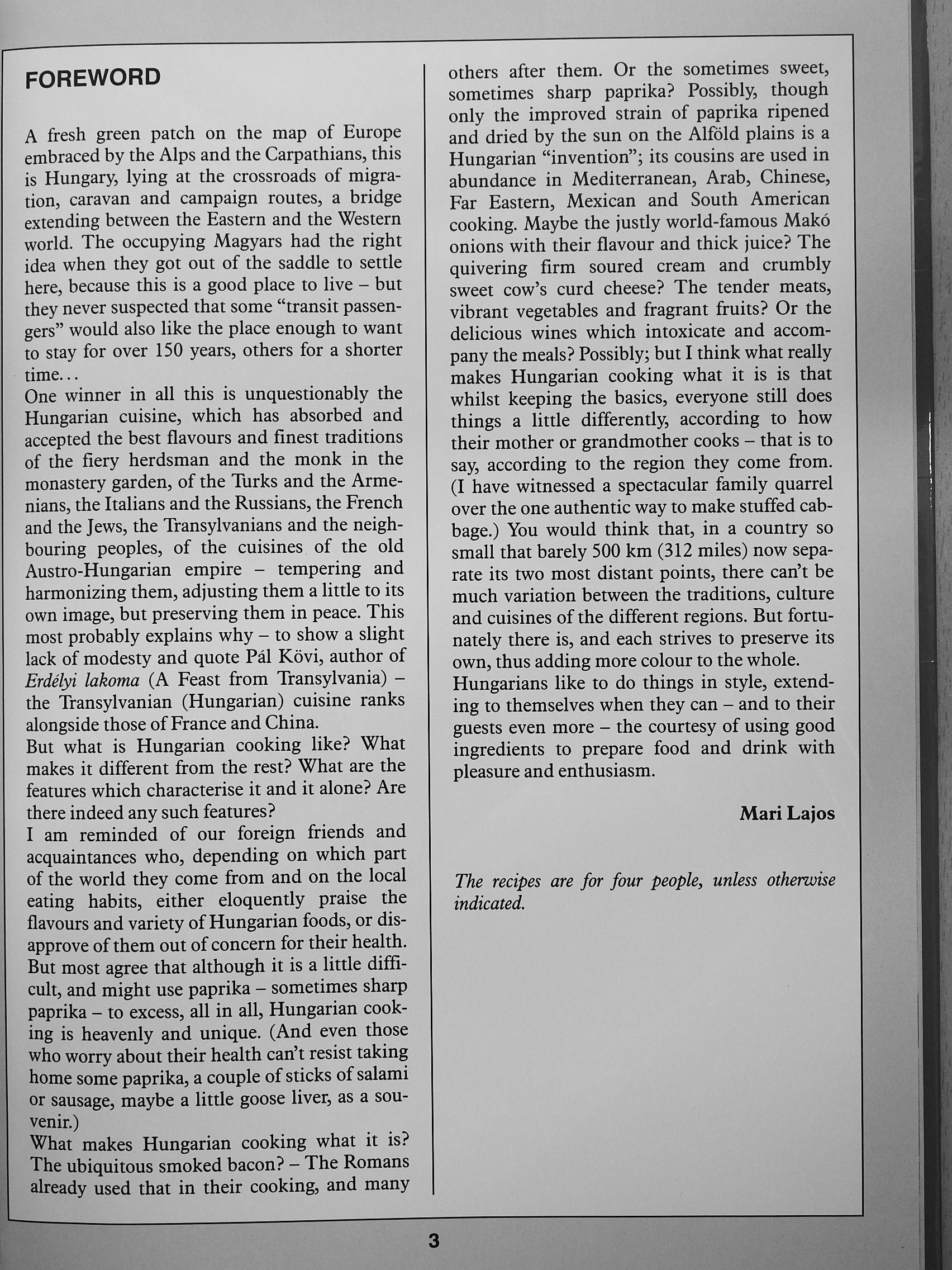
A fresh green patch on the map of Europe embraced by the Alps and the Carpathians, this is Hungary, lying at the crossroads of migration, caravan and campaign routes, a bridge extending between the Eastern and the Western world. The occupying Magyars had the right idea when they got out of the saddle to settle here, because this is a good place to live - but they never suspected that some "transit passengers" would also like the place enough to want to stay for over 150 years, others for a shorter time
One winner in all this is unquestionably the Hungarian cuisine, which has absorbed and accepted the best flavours and finest traditions of the fiery herdsman and the monk in the monastery garden, of the Turks and the Armenians, the Italians and the Russians, the French and the Jews, the Transylvanians and the neighbouring peoples, of the cuisines of the old Austro-Hungarian empire - tempering and harmonizing them, adjusting them a little to its own image, but preserving them in peace. This most probably explains why - to show a slight lack of modesty and quote Pál Kövi, author of Erdélyi lakoma (A Feast from Transylvania) -the Transylvanian (Hungarian) cuisine ranks alongside those of France and China. But what is Hungarian cooking like? What makes it different from the rest? What are the features which characterise it and it alone? Are there indeed any such features? I am reminded of our foreign friends and acquaintances who, depending on which part of the world they come from and on the local eating habits, either eloquently praise the flavours and variety of Hungarian foods, or disapprove of them out of concern for their health. But most agree that although it is a little difficult, and might use paprika - sometimes sharp paprika - to excess, all in all, Hungarian cooking is heavenly and unique. (And even those who worry about their health can't resist taking home some paprika, a couple of sticks of salami or sausage, maybe a little goose liver, as a souvenir.)
What makes Hungarian cooking what it is? The ubiquitous smoked bacon? - The Romans already used that in their cooking, and many
others after them. Or the sometimes sweet, sometimes sharp paprika? Possibly, though only the improved strain of paprika ripened and dried by the sun on the Alföld plains is a Hungarian "invention"; its cousins are used in abundance in Mediterranean, Arab, Chinese, Far Eastern, Mexican and South American cooking. Maybe the justly world-famous Makó onions with their flavour and thick juice? The quivering firm soured cream and crumbly sweet cow's curd cheese? The tender meats, vibrant vegetables and fragrant fruits? Or the delicious wines which intoxicate and accompany the meals? Possibly; but I think what really makes Hungarian cooking what it is is that whilst keeping the basics, everyone still does things a little differently, according to how their mother or grandmother cooks - that is to say, according to the region they come from. (I have witnessed a spectacular family quarrel over the one authentic way to make stuffed cabbage.) You would think that, in a country so small that barely 500 km (312 miles) now separate its two most distant points, there can't be much variation between the traditions, culture and cuisines of the different regions. But fortunately there is, and each strives to preserve its own, thus adding more colour to the whole. Hungarians like to do things in style, extending to themselves when they can - and to their guests even more - the courtesy of using good ingredients to prepare food and drink with pleasure and enthusiasm.
Mari Lajos
The recipes are for four people, unless otherwise indicated.
Termékadatok
Cím: 99 Hungarian Dishes with 33 Colour Photographs [antikvár]
Kiadó: Corvina
Kötés: Varrott keménykötés
ISBN: 9631342840
Méret: 200 mm x 280 mm
Új vásárló vagyok!
új vásárlóval indíthatsz rendelést............