


kategória
szerző
cím
sorozat
betöltés...
kiadó
betöltés...
ISBN
évszám
ár
-
leírás
Előrendelhető
A mezők bármelyike illeszkedjen
A mezők mind illeszkedjen


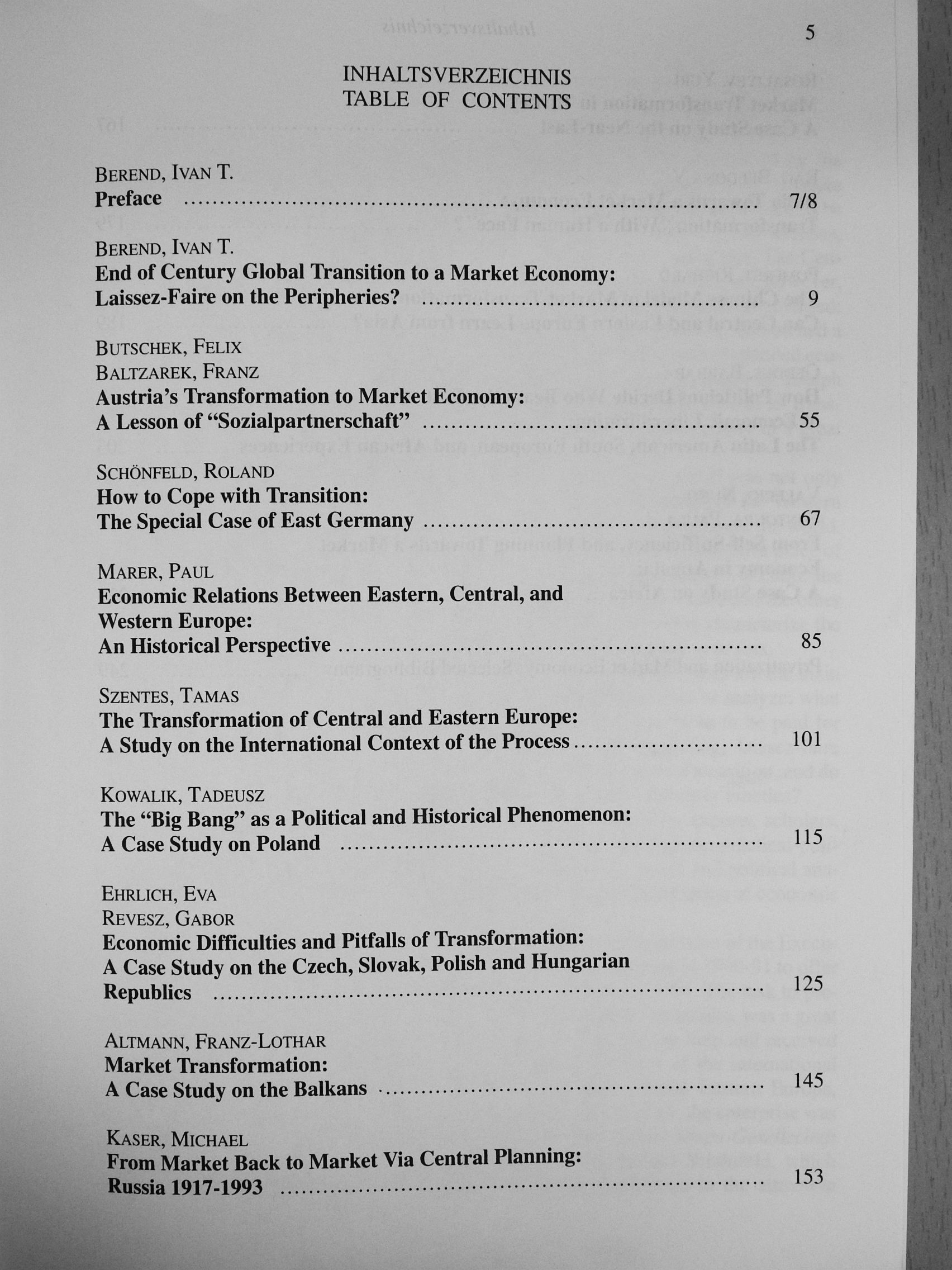
Transition to a Market Economy at the End of the 20th Century [antikvár]
Felix Butschek, Paul Marer, Tadeusz Kowalik

PREFACE
The last two decades of the waning 20th century have been characterized by the spectacular world-wide victory of a self-regulating market economy. The system which was aggressively challenged at the beginning of the century and seemed to be buried under the ruins of a devastating war and depression in the interwar decades, was triumphantly reborn after Worid War 11 in the Western core countries. The Central and Eastern European, Asian, African and Latin American peripheries, however, stronger than ever, turned to alternative models....
online ár:
Webáruházunkban a termékek mellett feltüntetett fekete színű online ár csak internetes megrendelés esetén érvényes.
15000 Ft

Részletesen erről a termékről
Bővebb ismertető
PREFACE
The last two decades of the waning 20th century have been characterized by the spectacular world-wide victory of a self-regulating market economy. The system which was aggressively challenged at the beginning of the century and seemed to be buried under the ruins of a devastating war and depression in the interwar decades, was triumphantly reborn after Worid War 11 in the Western core countries. The Central and Eastern European, Asian, African and Latin American peripheries, however, stronger than ever, turned to alternative models. Modernizing dictatorships emerged; the state had a strict control over the economy and, in several countries, also owned a great part of it. More than one third of the world introduced some kind of planned economy with an overwhelming state control and ownership. The prophecy of Joseph Schumpeter at the end of the 1920s regarding the decline of capitalism and its transformation into a victoriously spreading socialism seemed to be the reality in a great and, between the fifties and seventies, growing part of the worid.
From the mid to late seventies on, however, the international trend was not only halted but sharply and spectacularly reversed. The successful model of the Western core became the admired, praised and recognized pattern to follow all over the world. The Zeitgeist dramatically changed and irresistably penetrated even the birth place of the former alternative model, the home land of planning and state-ownership, the (former) Soviet Union and the state socialist countries in Europe, Asia, and the other peripheries and continents. Market transformation and privatization characterize the economies of Latin America, Africa and Asia. The world economy is in flux.
What happened? Why did it happen? What were the causes and what are the main characteristics of this transformation? What is even more important to analyze: what are the consenquences? What kind of economic and social cost have to be paid for such a transformation? Was the chosen model of a self-regulating, laissez-faire market system adequate? What are the lessons of the first chapter of transition, and do they challenge the universally accepted model of the eighties and early nineties?
These are crucial questions which require a proper answer by experts, scholars, policy makers and governments. Although these questions are burning practical-political issues of the present and future, and initiate economic, social and political analyses, a proper understanding is hardly possible without an interpretation of economic history.
This world-wide intellectual-political challenge initiated the decision of the Executive Committee of the International Economic History Association in 1990-91 to offer a special session on the topic at its Xlth Congress in Milan in 1994. The task to prepare Session A/3 at the Milan Congress, which 1 was asked to undertake, was a great honor and also a similariy great burden. Fortunately, 1 gained the help and received the contributions of an excellent team, composed of members of the international community of economic historians and economists from Central Eastern Europe, Western Europe, the United States, India and Australia. Most of all, the enterprise was immediately recognized and highly sponsored by the Siidosteiimpa-Gesellscluift (Munich), and personally by its Managing Director, Dr. Roland Schonfeld, which made it possible to organize an excellent preparatory conference in the attractive
Termékadatok
Cím: Transition to a Market Economy at the End of the 20th Century [antikvár]
Kiadó: Südosteuropa-Gesellschaft
Kötés: Ragasztott papírkötés
ISBN: 3925450440
Méret: 160 mm x 220 mm
Új vásárló vagyok!
új vásárlóval indíthatsz rendelést............