


kategória
szerző
cím
sorozat
betöltés...
kiadó
betöltés...
ISBN
évszám
ár
-
leírás
Előrendelhető
A mezők bármelyike illeszkedjen
A mezők mind illeszkedjen


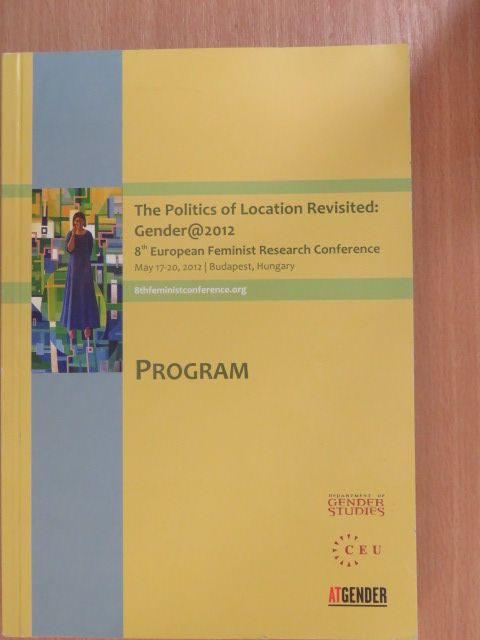
The Politics of Location Revisited: Gender@2012 - 8th European Feminist Research Conference [antikvár]
Asszisztencia Kft.
,
Megjelenés: 2012. január 01.

WELCOME TO THE 8th EUROPEAN FEMINIST RESEARCH CONFERENCEThe CEU Gender Studies Department and AtGender, The European Association for Gender Research,Education and Documentation, are proud to host the 8th European Feminist Research Conference,The Politics of Location Revisited: Gender@2012 (8th EFRC, May 17-20, 2012, Budapest).With more than 500 participants from across Europe, as well as other parts of the world, and withmore than 150 participants from Central and Eastern Europe, the 8th EFRC will be the largest feministconference held in...
online ár:
Webáruházunkban a termékek mellett feltüntetett fekete színű online ár csak internetes megrendelés esetén érvényes.
2480 Ft

Részletesen erről a termékről
Bővebb ismertető
WELCOME TO THE 8th EUROPEAN FEMINIST RESEARCH CONFERENCEThe CEU Gender Studies Department and AtGender, The European Association for Gender Research,Education and Documentation, are proud to host the 8th European Feminist Research Conference,The Politics of Location Revisited: Gender@2012 (8th EFRC, May 17-20, 2012, Budapest).With more than 500 participants from across Europe, as well as other parts of the world, and withmore than 150 participants from Central and Eastern Europe, the 8th EFRC will be the largest feministconference held in Budapest in more than sixty years, since the 1913 Congress of the InternationalWoman Suffrage Alliance and the 1948 Congress of the Women's International DemocraticFederation.The 8th European Feminist Research Conference is hosted by an international university that has justcommemorated its 20th anniversary, and a Department of Gender Studies that has just celebratedthe 15th anniversary of its accreditation. With a large international faculty and international studentbody, four MA programs and a Ph.D. program, the Department has become an academic strongholdin the field of Gender Studies in Europe and beyond. It is a place where local and global perspectivesare brought together, both theoretically and in practice. Like the CEU generally, the Departmentcherishes its regional roots and its international character; it cooperates intensively with its Hungariancolleagues, and maintains a strong presence in international academia.The making of European Gender Studies happens not just at university departments but also atfeminist research conferences.This conference is part of a longltradition of bringing together Europeanfeminist and gender studies scholars, professionals, and activists who seek to merge specific problemsof feminist knowledge production with practical work'in the field'within the dynamic framework oflarge, inclusive conferences.The previous European feminist research conferences at the universitiesof Alborg (1991), Graz (1994), Coimbra (1997), Bologna (2000), Lund (2003), todz (2006), and Utrecht(2009) were co-organized by ATHENA, the Advanced Thematic Network of Women's Studies inEurope, whose activities substantially contributed to the growth of the European dimensions andinstitutional developments of the scholarly fields of gender, women's and feminist studies. The factthat ATHENA could no longer rely on funding from the European Commission was the main impetusfor establishing in 2009 a legally independent, membership-based feminist association: AtGender.AtGender has taken over ATHENA's important legacy and is working to develop it further. This is thefirst European Feminist Research Conference co-organized by AtGender, which welcomes its newand old institutional, individual and student members, and encourages them to explore the potentialoffered by the new organization, and this conference, for networking and exchanging ideas aboutEuropean feminist research, education and documentation.The 8th EFRC takes place at a difficult time for Europe, difficult because of the current global economiccrisis, austerity measures and high unemployment rates. These developments affect men andwomen differently, with women being 70 % of the poor globally. The current economic crisis hasalso strengthened conservative, right-wing, populist and extremist reactions in many Europeancountries, which are negatively affecting women, ethnic minorities, migrants and those with non-normative gender and sexual identities. Hence the present situation threatens to reverse gains madein women's position since the 1970s.Such difficult times demand a proper response, one based on critical awareness of and thinking aboutgender. In such a precarious situation, feminist theory offers socially relevant and morally responsibleknowledge of the world we are living in; it also produces new visions and tools for creating another,more just world.One of the aims of this conference is to address the challenges of the current moment, showing thatthey can neither be understood nor addressed without a critical gender perspective. That is why oneof the themes of the conference is intersectionality, a theoretical and methodological approach thatwas created within the broader field of women's studies/gender studies. Intersectionality offers aninterpretative framework to address the complex relations between different axes of social oppressionand the multiple aspects of both personal and collective identities.
Termékadatok
Cím: The Politics of Location Revisited: Gender@2012 - 8th European Feminist Research Conference [antikvár]
Kiadó: Asszisztencia Kft.
Megjelenés: 2012. január 01.
Kötés: Ragasztott papírkötés
ISBN: 9789638898111
Méret: 160 mm x 230 mm
Új vásárló vagyok!
új vásárlóval indíthatsz rendelést............