


kategória
szerző
cím
sorozat
betöltés...
kiadó
betöltés...
ISBN
évszám
ár
-
leírás
Előrendelhető
A mezők bármelyike illeszkedjen
A mezők mind illeszkedjen



Preface
The vignettes of Stalin and his age assembled in this volume do not claim to offer a history of Stalinism. Based on a number of Radio Free Europe/ Radio Liberty 'Third Programme' broadcasts, they are, rather, looking-glasses hung up at odd corners from which come to life now this, now that aspect of the rule of Stalin and the political and historical environment which made that rule possible. Whether they cohere into some semblance of unity or disband in confusion is for the reader to judge. Mv purpose was to append a long footnote...
online ár:
Webáruházunkban a termékek mellett feltüntetett fekete színű online ár csak internetes megrendelés esetén érvényes.
7980 Ft

Részletesen erről a termékről
Bővebb ismertető
Preface
The vignettes of Stalin and his age assembled in this volume do not claim to offer a history of Stalinism. Based on a number of Radio Free Europe/ Radio Liberty 'Third Programme' broadcasts, they are, rather, looking-glasses hung up at odd corners from which come to life now this, now that aspect of the rule of Stalin and the political and historical environment which made that rule possible. Whether they cohere into some semblance of unity or disband in confusion is for the reader to judge. Mv purpose was to append a long footnote to the scholarly study of Stalin and Stalinism, and I hoped to do this by tapping the resources of men who either knew and worked with Stalin (Bazhanov, Djilas, Harriman, Kennan), were in one way or another at the receiving end of Stalinism (Kolakowski, Prager, Bao) or spent many years in the study of tyrannical leadership, and the character of the leaders and the led, in the Soviet Union and China (Schapiro, Ulam, Tucker, MacFarquhar). These categories naturally overlap, some of the dialogues spinning off into the discussion of questions which, though compelling in themselves, are only loosely connected with the life and times of Stalin.
I have, nevertheless, incorporated them in toto for two principal reasons. First, George Kennan, Milovan Djilas, Leszek Kolakowski and W. Averell Harriman, even when they do not focus on the phenomenon of Stalin, speak to us as witnesses of an age which had the imprint of Stalinism widely and continuously stamped on its profile, for Stalinism (or, as Solzhenitsyn would tell us, Leninism) was an established feature of Soviet life well before Stalin actually came to be the sole ruler of the USSR, and has remained so since his death. Secondly, to have narrowly limited our scope to Stalin and his works would have deprived this symposium of the benefit of some of the experiences of men whose significance in contemporary history and polidcal thinking needs no jusdfication in terms of their relationship with Stalin. They are their own men and talk to us in their own right, but their voices, even when they do
Termékadatok
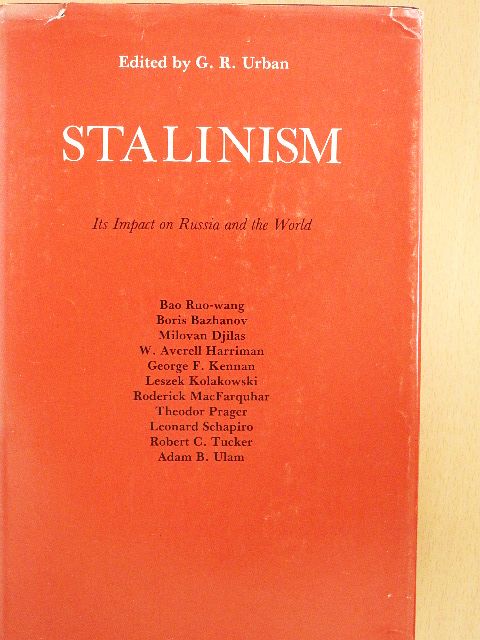
Cím: Stalinism [antikvár]
Kiadó: Maurice Temple Smith Ltd
Kötés: Varrott keménykötés
ISBN: 0851172237
Méret: 160 mm x 240 mm
Új vásárló vagyok!
új vásárlóval indíthatsz rendelést............