


kategória
szerző
cím
sorozat
betöltés...
kiadó
betöltés...
ISBN
évszám
ár
-
leírás
Előrendelhető
A mezők bármelyike illeszkedjen
A mezők mind illeszkedjen


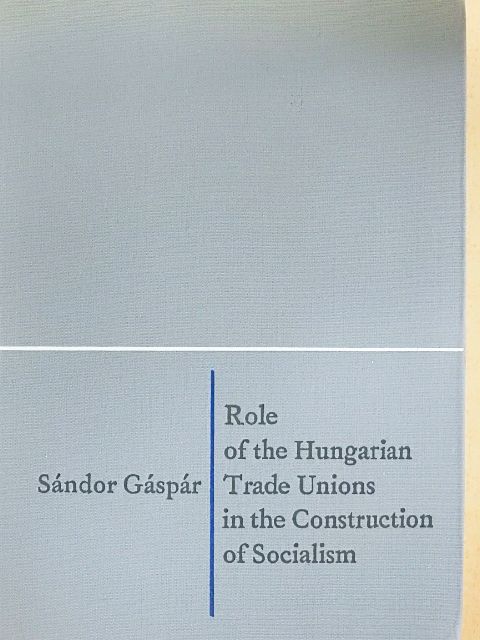
Role of the Hungarian Trade Unions in the Construction of Socialism [antikvár]
Gáspár Sándor, Sándor Gáspár

INTRODUCTION
Tie aim of this work is to give a short review of the development of the Hungarian trade union movement, further to show what function the trade unions fulfil under various social conditions. Our main conclusions drawn in the course of building Socialism are summed up, and the strivings that are characteristic of trade unions today are outlined. 'Naturally, we deal not only with theoretical questions, but also with various concrete tasks of the Hungarian trade unions. They are indicated in detail.
The position and role of the...
online ár:
Webáruházunkban a termékek mellett feltüntetett fekete színű online ár csak internetes megrendelés esetén érvényes.
1340 Ft

Részletesen erről a termékről
Bővebb ismertető
INTRODUCTION
Tie aim of this work is to give a short review of the development of the Hungarian trade union movement, further to show what function the trade unions fulfil under various social conditions. Our main conclusions drawn in the course of building Socialism are summed up, and the strivings that are characteristic of trade unions today are outlined. 'Naturally, we deal not only with theoretical questions, but also with various concrete tasks of the Hungarian trade unions. They are indicated in detail.
The position and role of the Hungarian trade union movement in Socialist construction can be determined only if—in the course of our study—reference is made to the main experiences of both the international and the Hungarian trade union movements. We do not wish to give a historical survey, but to show the most characteristic features of the development. This, however, does not mean that we do not appreciate, do not esteem, for instance, the great values of the heroic struggles of the Hungarian working class in the century-old history of the Hungarian trade union movement. "But the aim of this book is not to review the history of the Hungarian trade union movement. That will be a later and significant task of ours. At the same time we think that it is easier to understand and to make understood—with certain historical references—the changes according to the laws of society that are characteristic of the development in the Hungarian trade union movement of today.
In this country, the leading role of the working class predominates increasingly. It has become the decisive force in our social development. The trade unions, as regards their origin and character, are organit^ations of the tvorking class. Therefore, under Socialist conditions, they play afundamentalpart in the realit^ation of the leading role of the working class. A recognition of this is essentially important as far as the fulfilment of the function of the trade unions is concerned. In making good the leading role of the working class, the trade unions have common tasks with the other organs existing in the system of proletarian dictatorship, but they have their own particular features as well.
The leading role of the working class—and so also the role of the trade unions—is not independent of either space or time. It must always be adjusted to the tasks
Termékadatok
Cím: Role of the Hungarian Trade Unions in the Construction of Socialism [antikvár]
Kiadó: Táncsics Publishing House
Kötés: Vászon
Méret: 150 mm x 200 mm
Új vásárló vagyok!
új vásárlóval indíthatsz rendelést............