


kategória
szerző
cím
sorozat
betöltés...
kiadó
betöltés...
ISBN
évszám
ár
-
leírás
Előrendelhető
A mezők bármelyike illeszkedjen
A mezők mind illeszkedjen


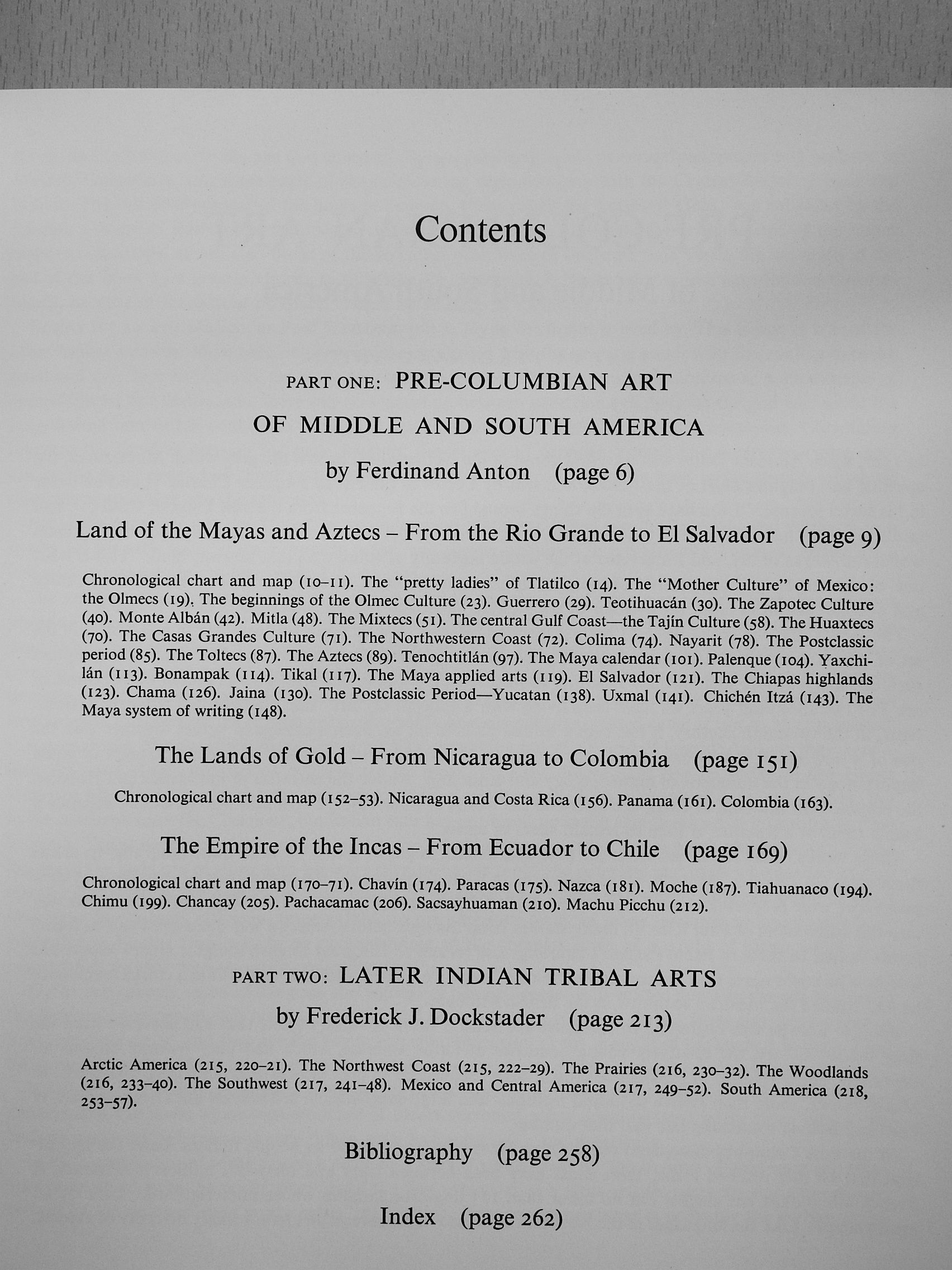
Pre-Columbian Art and Later Indian Tribal Arts [antikvár]
Ferdinand Anton, Frederick J. Dockstader

PART ONE:
PRE-COLUMBIAN ART
of Middle and South America
TEXT BY FERDINAND ANTON
In 1520, when Albrecht Dürer was traveling about in the Netherlands, he saw the gifts which Moctezuma, the spiritual and religious chief of the Aztecs, had sent by Cortés to present to Emperor Charles V, and he wrote in his travel journal: 'M too have seen the things brought to the Emperor from the new Land of Gold . . . and in all my life I have never seen anything which so stirred my heart as those objects. For I saw among them wonderful works of art,...
online ár:
Webáruházunkban a termékek mellett feltüntetett fekete színű online ár csak internetes megrendelés esetén érvényes.
5540 Ft

Részletesen erről a termékről
Bővebb ismertető
PART ONE:
PRE-COLUMBIAN ART
of Middle and South America
TEXT BY FERDINAND ANTON
In 1520, when Albrecht Dürer was traveling about in the Netherlands, he saw the gifts which Moctezuma, the spiritual and religious chief of the Aztecs, had sent by Cortés to present to Emperor Charles V, and he wrote in his travel journal: 'M too have seen the things brought to the Emperor from the new Land of Gold . . . and in all my life I have never seen anything which so stirred my heart as those objects. For I saw among them wonderful works of art, and I marveled at the subtle ingenuity of those men in a faraway land.'* This is what one of the most significant artists of the sixteenth century thought of early American art. And yet, three and one-half centuries later, the director of the Louvre refused to exhibit such objects in his museum.
The fact is that the rediscovery of early American art had to wait upon our century. It was not only the art of Africa that stimulated the imaginations of modern painters like Picasso and Paul Klee and sculptors such as Henry Moore and Jacques Lipchitz, to mention only a few, but also, and as much, Pre-Columbian art. For two thousand years we have been living with a concept of "art" that we inherited from the Greeks. Now, in the twentieth century, it has begun to lose its hold on us. Such a change in values together with the rise of a new set of values has meant that museums of art have acquired new partners—partners of equal importance—in the museums of anthropology and ethnology. Above the entrance of the Musée de l'Homme, the ethnological museum in Paris, are inscribed the words of Paul Valéry : "On him who passes by depends if I am a tomb or a treasure, if I am to remain silent or speak."
Those works of art reclaimed from the past did, indeed, begin to speak. At first, quite naturally, to artists themselves. In Dresden, Munich, and London, as in Paris, they aroused the enthusiasm of men who, in their own ways, were preparing a revolution in Western art. Many a textile pattern from ancient Peru made its way into the watercolors of Paul Klee. In many statues from the time before America was discovered can be found forms similar to those in Pablo Picasso's paintings and ceramics. The great English sculptor Henry Moore has told how he could never find the courage to create a "negative space," a hollow void within a closed form, until he had studied the Mexican sculpture in the British Museum.
Because Europe was beginning to recognize the artistic value of those objects that had survived from the time before history, the relatively young countries of Latin America, which had only recently become independent of the Spanish or Portuguese crown, were encouraged in their efforts to explore their own pasts. In Mexico alone, more than twelve thousand medium- and large-sized ancient settlements have been studied; in Peru and Bolivia something like half that number.
At the time Columbus discovered the Western Hemisphere and called its people Indians under the impression that he had reached India, there must have been between forty and forty-five million inhabitants. A French ethnologist has singled out no fewer than 123 linguistic families whose interrelationships are by no means simple. Like the languages of the New World, so too-its art reveals an extraordinary diversity of aspects.
Termékadatok
Cím: Pre-Columbian Art and Later Indian Tribal Arts [antikvár]
Kiadó: Harry N. Abrams
Kötés: Vászon
Méret: 200 mm x 230 mm
Új vásárló vagyok!
új vásárlóval indíthatsz rendelést............