


kategória
szerző
cím
sorozat
betöltés...
kiadó
betöltés...
ISBN
évszám
ár
-
leírás
Előrendelhető
A mezők bármelyike illeszkedjen
A mezők mind illeszkedjen


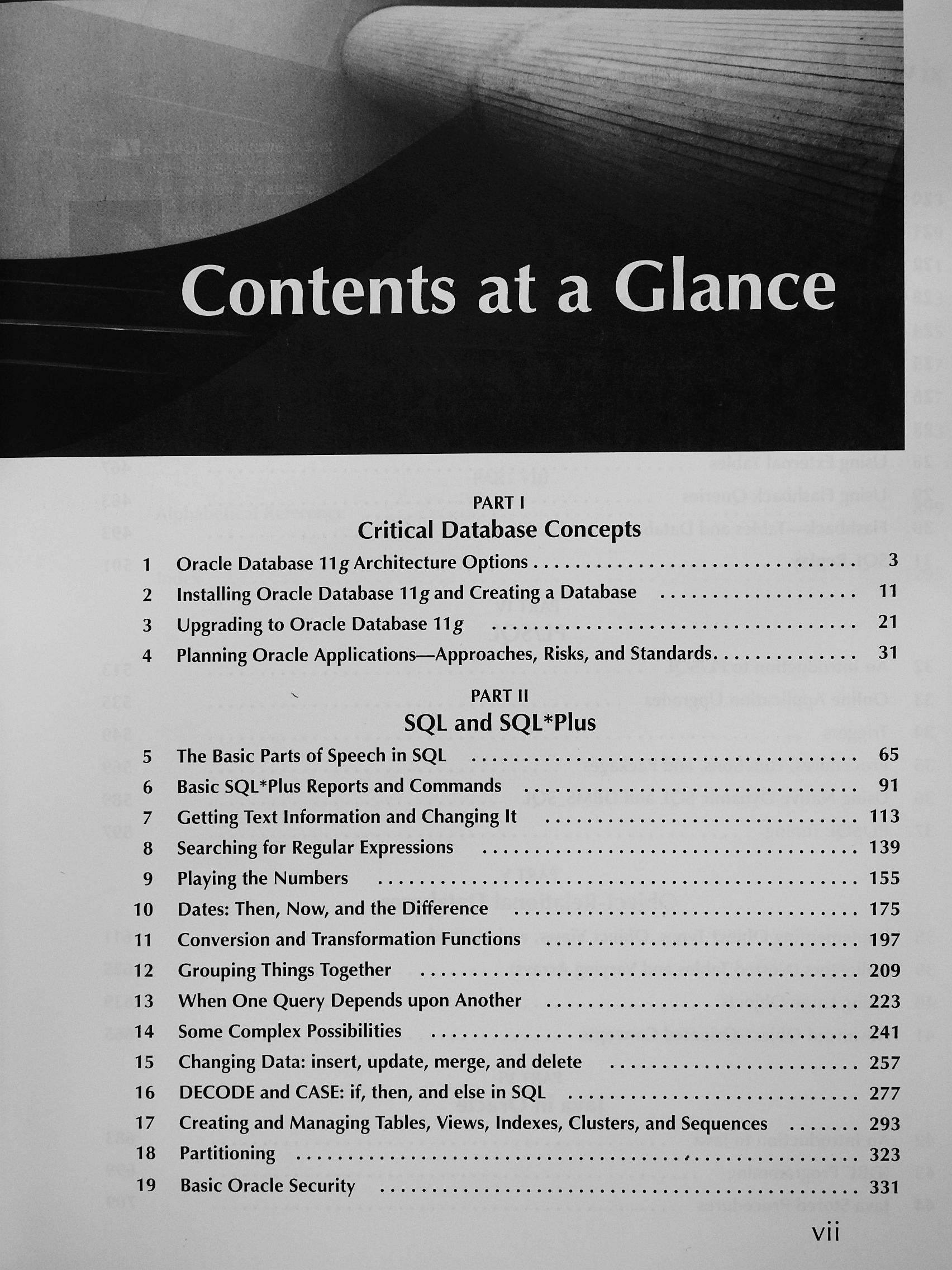

Part I: Critical Database Concepts
racle Database 11 g is a significant upgrade from prior releases of Oracle. New features give developers, database administrators, and end users greater control over the storage, processing, and retrieval of their data. In this chapter, you will see highlights of the Oracle Database 11 g architecture. You will see detailed ' discussions of new features such as SQL replay, change management, and result caching in later chapters. The goal of this chapter is to present a high-level overview of the...
online ár:
Webáruházunkban a termékek mellett feltüntetett fekete színű online ár csak internetes megrendelés esetén érvényes.
8980 Ft

Részletesen erről a termékről
Bővebb ismertető
Part I: Critical Database Concepts
racle Database 11 g is a significant upgrade from prior releases of Oracle. New features give developers, database administrators, and end users greater control over the storage, processing, and retrieval of their data. In this chapter, you will see highlights of the Oracle Database 11 g architecture. You will see detailed ' discussions of new features such as SQL replay, change management, and result caching in later chapters. The goal of this chapter is to present a high-level overview of the capabilities you can feature in your Oracle applications and provide an introduction to the chapters that describe them.
This book is divided into eight major sections.
In Part I, "Critical Database Concepts," you will see an overview of Oracle Database llg's options, how to install the Oracle software, how to create or upgrade a database, and advice on planning your application implementation. These chapters establish the common vocabulary that both end users and developers can use to coherently and intelligently share concepts and ensure the success of any development effort. This introductory chapter and Chapter 4 are intended for both developers and end users of Oracle; Chapters 2 and 3 are intended for database administrators.
Part II, "SQL and SQL*Plus," teaches the theory and techniques of relational database systems and applications, including SQL (Structured Query Language) and SQL*Plus. The section begins with relatively few assumptions about data-processing knowledge on the part of the reader and then advances, step by step, through some very deep issues and complex techniques. The method very consciously uses clear, conversational English, with unique and interesting examples, and strictly avoids the use of undefined terms or jargon. This section is aimed primarily at developers and end users who are new to Oracle or need a quick review of certain Oracle features. It moves step by step through the basic capabilities of SQL and Oracle's interactive query facility, SQL*Plus. When you've completed this section, you should have a thorough understanding of all SQL keywords, functions, and operators. Within an Oracle database, you should be able to produce complex queries, create tables, and insert, update, and delete data.
Part 111, "Beyond the Basics," covers advanced options, including virtual private databases. Data Pump, replication, text indexing, external tables, change replay, and the use of the flashback options for developers and database administrators. Most of the features described in this section will not be directly used by end users, but the applications they use can be based on these features.
Part IV, "PL/SQL," provides coverage of PL/SQL. The topics include a review of PL/SQL structures, plus triggers, stored procedures, and packages. Both standard and native dynamic PL/SQL is covered.
Part V, "Object-Relational Databases," provides extensive coverage of object-oriented features such as abstract datatypes, methods, object views, object tables, nested tables, varying arrays, and large objects.
Part VI, "Java in Oracle," provides coverage of the Java features in the Oracle database. This section includes an overview of Java syntax as well as chapters on JDBC and Java stored procedures.
Part VII, "Hitchhiker's Guides," provides an overview of the Real Application Cluster and grid architecture available in Oracle Database 11 gas well as case studies in using Oracle's tuning tools, the new features such as the client-side cache, an overview of database administration, and a high-level description of the use of XML in Oracle.
Part VIM, "Alphabetical Reference," is a reference for the Oracle server—a book unto itself. Reading the introductory pages to this reference will make its use much more effective and understandable. This section contains references for most major Oracle commands, keywords, products, features, and functions, with extensive cross-referencing of topics. The reference is
Termékadatok
Cím: Oracle Database 11g: The Complete Reference [antikvár]
Szerző:
Kevin Loney
Kiadó: McGraw-Hill Companies
Kötés: Fűzött kemény papírkötés
ISBN: 9780071598750
Méret: 190 mm x 240 mm
Új vásárló vagyok!
új vásárlóval indíthatsz rendelést............