


kategória
szerző
cím
sorozat
betöltés...
kiadó
betöltés...
ISBN
évszám
ár
-
leírás
Előrendelhető
A mezők bármelyike illeszkedjen
A mezők mind illeszkedjen


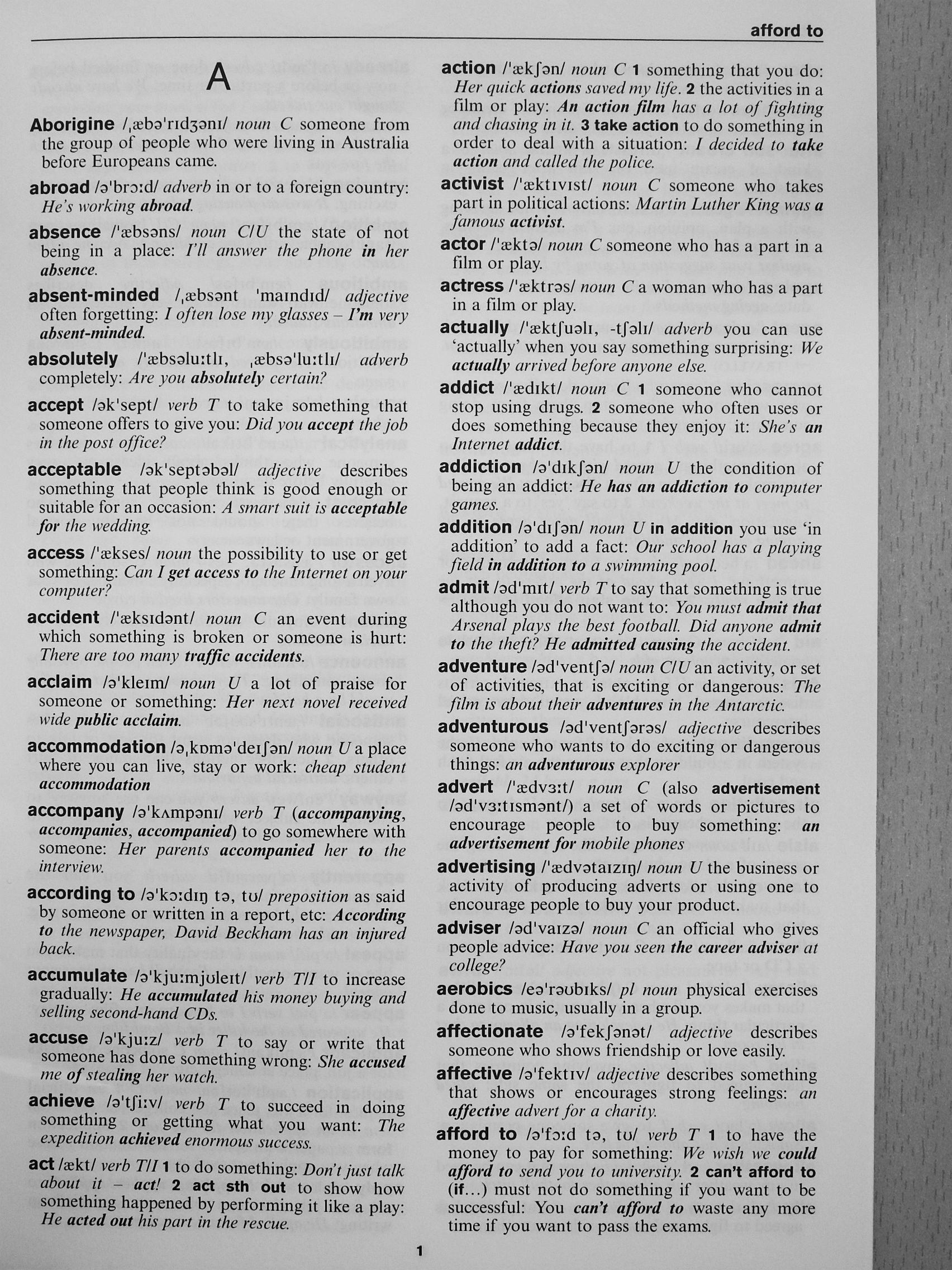
New Opportunities - Intermediate - Mini-Dictionary [antikvár]
Christina Ruse

afford to
A
Aborigine /.aibo'ridsoni/ uoim C someone from the group of people who were living in Australia before Europeans came.
abroad /s'brDjd/ adverb in or lo a foreign country: He's working abroad.
absence /'sebsans/ noun CIV the state of not being in a place: I'll answer the phone in her absence.
absent-minded /la'bsont 'mamdid/ adjective often forgetting: I often lose my glasses - Fm very absent-minded.
absolutely /'aebsaluitli, ,Lebs3'lu:tli/ adverb completely: Are you absolutely certain?
accept /ak'sept/ verb T to take...
online ár:
Webáruházunkban a termékek mellett feltüntetett fekete színű online ár csak internetes megrendelés esetén érvényes.
1140 Ft

Részletesen erről a termékről
Bővebb ismertető
afford to
A
Aborigine /.aibo'ridsoni/ uoim C someone from the group of people who were living in Australia before Europeans came.
abroad /s'brDjd/ adverb in or lo a foreign country: He's working abroad.
absence /'sebsans/ noun CIV the state of not being in a place: I'll answer the phone in her absence.
absent-minded /la'bsont 'mamdid/ adjective often forgetting: I often lose my glasses - Fm very absent-minded.
absolutely /'aebsaluitli, ,Lebs3'lu:tli/ adverb completely: Are you absolutely certain?
accept /ak'sept/ verb T to take something that someone offers to give you: Did you accept the job in the post ojfice?
acceptable /ak'septsbsl/ adjective describes something that people think is good enough or suitable for an occasion: A smart suit is acceptable for the wedding.
access /'?ekses/ noun the possibility to use or get something: Can I get access to the Internet on your computer?
accident /'aeksidsnt/ noun C an event during which something is broken or someone is hurl: There are too many traffic accidents.
acclaim /s'kleim/ noun U a lot of praise for someone or something: Her next novel received wide public acclaim.
accommodation/a,kDm3'deij9n//i0i//i i7a place where you can live, stay or work: cheap student accommodation
accompany /s'kAmpam/ verb T {accompanying, accompanies, accompanied) to go somewhere with someone: Her parents accompanied her to the interview.
according to /a'koidig ta, tu/ preposition as said by someone or written in a report, etc: According to the newspaper, David Beckham has an injured back.
accumulate /a'kjuimjuleit/ verb TU lo increase gradually: He accumulated his money buying and selling second-hand CDs.
accuse /a'kjuiz/ verb T to say or write that someone has done something wrong: She accused me of stealing her watch.
achieve /s'tjiiv/ verb T to succeed in doing something or getting what you want; The expedition achieved enormous success.
act /aekt/ verb TU 1 to do something: Don't just talk about it - act! 2 act sth out to show how something happened by performing it like a play: He acted out his part in the rescue.
action /'ick/sn/ noun C 1 something that you do: Her quick actions saved my life. 2 the activities in a nim or play: An action film has a lot of Jighting and chasing in ii. 3 take action to do something in order lo deal with a situation: / decided to take action and called the police. activist /'asktivist/ noun C someone who takes part in political actions: Martin Luther King was a j'amous activist. actor /'a:kl3/ noun C someone who has a part in a film or play.
actress /'sktrss/ noun Ca woman who has a part
in a film or play, actually /'?ektjuali, -tjsli/ adverb you can use 'actually' when you say something surprising: We actually arrived before anyone else. addict /'iedikt/ noun C 1 someone who cannot slop using drugs. 2 someone who often uses or does something because they enjoy it: She's an Internet addict. addiction /a'dikjan/ noun U the condition of being an addict: He has an addiction to computer games.
addition /s'dijsn/ noun U In addition you use 'in addition' to add a fact: Our school has a playing field in addition to a swimming pool admit /od'md/ verb T to say that something is true although you do not want lo: You must admit that Arsenal plays the best football. Did anyone admit to the theft? He admitted causing the accident. adventure /sd'ventja/ noim ClU an activity, or set of activities, thai is exciting or dangerous: The film is about their adventures in the Antarctic. adventurous /sd'ventjsras/ adjective describes someone who wants lo do exciting or dangerous things: an adventurous explorer advert /'sdvsit/ noun C (also advertisement /sd'vailismanl/) a set of words or pictures lo encourage people lo buy something: an advertisement for mobile phones advertising /'aedvataizig/ noun U the business or activity of producing adverts or using one to encourage people to buy your product, adviser /ad'vaiza/ noun C an official who gives people advice: Have you seen the career adviser at college?
aerobics /ea'raubiks/ pi noun physical exercises
done lo music, usually in a group, affectionate /a'fekjonot/ adjective describes
someone who shows friendship or love easily, affective /a'fekliv/ adjective describes something thai shows or encourages strong feelings: an affective advert for a charity. afford to /a'foid la, tu/ verb T 1 to have the money to pay for something: IVe wish we could afford to send you to university. 2 can't afford to (if ) must not do something if you want lo be successful: You can't afford to waste any more lime if you want to pass the exams.
m^rl
Termékadatok
Cím: New Opportunities - Intermediate - Mini-Dictionary [antikvár]
Szerző:
Christina Ruse
Kötés: Tűzött kötés
ISBN: 9780582854154
Méret: 150 mm x 210 mm
Új vásárló vagyok!
új vásárlóval indíthatsz rendelést............