


kategória
szerző
cím
sorozat
betöltés...
kiadó
betöltés...
ISBN
évszám
ár
-
leírás
Előrendelhető
A mezők bármelyike illeszkedjen
A mezők mind illeszkedjen


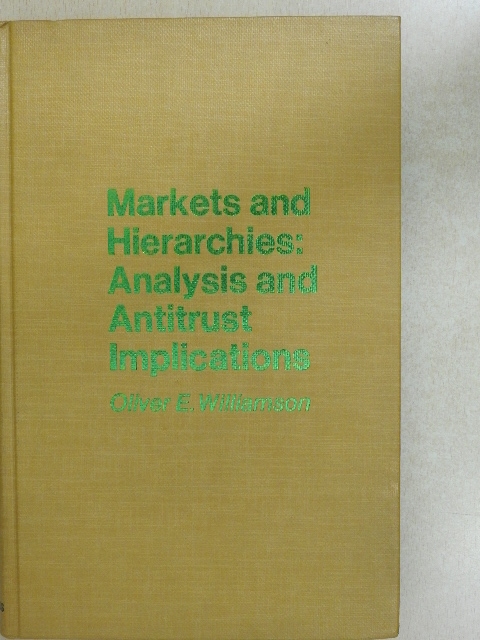
Markets and Hierarchies: Analysis and Antitrust Implications [antikvár]
Oliver E. Williamson

Preface
This book is concerned with the organization of economic activity within and between markets and hierarchies. Whereas market transactions involve exchange between autonomous economic entities — the study of which exchanges is the familiar object of microeconomic analysis — hierarchical transactions are ones for which a single administrative entity spans both sides of the transaction, some form of subordination prevails, and, typically, consolidated ownership obtains.
Also, whereas received microtheory generally regards the...
online ár:
Webáruházunkban a termékek mellett feltüntetett fekete színű online ár csak internetes megrendelés esetén érvényes.
15000 Ft

Részletesen erről a termékről
Bővebb ismertető
Preface
This book is concerned with the organization of economic activity within and between markets and hierarchies. Whereas market transactions involve exchange between autonomous economic entities — the study of which exchanges is the familiar object of microeconomic analysis — hierarchical transactions are ones for which a single administrative entity spans both sides of the transaction, some form of subordination prevails, and, typically, consolidated ownership obtains.
Also, whereas received microtheory generally regards the organization of economic activity between firms and markets as a datum, the study of markets and hierarchies expressly attempts to assess the efficiency pro-perdes of alternative contracting modes. Correspondingly, while conventional analysis is largely preoccupied with the investigation of final product markets, the study of markets and hierarchies entails, additionally, an intensive examination of labor market, intermediate product market, and capital market related transacdons.
I contend in this connecdon that the modeling apparatus of received microtheory is insufficiently microanalydc to deal with many of the transactional phenomena of interest. What is referred to as the "organizational failures framework" is proposed and repeatedly employed in an attempt to assess the efficacy of completing related sets of transactions across a market or within a firm.
Although I espouse a somewhat unconventional worldview, students and followers of John R. Commons will recognize that I subscribe to his dictum that the transaction is the ultimate unit of microeconomic analysis. This position has never enjoyed widespread acceptance, even during Commons's period of maximum influence —which has waned considerably. Whether I have made a more compelling case is uncertain. Nevertheless, it is of interest to observe that the analysis of transactions was regarded by Commons and other institutionalists as central to the study of economics.
My treatment differs from the institutionalists in at least three ways. First, I am able to draw on an extensive market failure literature that was unavailable forty years ago. This is a considerable advantage. Second, rather than regard the microanalytic study of markets and hierarchies as being in essential conflict with received microtheory, I am inclined to consider these as complements. The transactional approach is held to be useful to the extent that it produces fruitful insights and systematically
xi
Termékadatok
Cím: Markets and Hierarchies: Analysis and Antitrust Implications [antikvár]
Szerző:
Oliver E. Williamson
Kötés: Fűzött keménykötés
ISBN: 0029353602
Méret: 160 mm x 240 mm
Új vásárló vagyok!
új vásárlóval indíthatsz rendelést............