


kategória
szerző
cím
sorozat
betöltés...
kiadó
betöltés...
ISBN
évszám
ár
-
leírás
Előrendelhető
A mezők bármelyike illeszkedjen
A mezők mind illeszkedjen



Early Works
Probably sometime in the 1470s Giovanni Santi, a mediocre painter best known because he was Raphael's father, wrote a Rhiimed Chronicle listing all the major painters of the time. He included the artists of the previous generation (Masaccio and Fra Angélico, Filippo Lippi and Domenico Venezi-ano), the great patriarch Piero della Francesca and ail the younger painters, Leonardo and Perugino, Sandro Botticelli, Filippino Lippi and Luca Sig-norelli. Looking at the art worid from the viewpoint of his home town, Urbino, one of the...
online ár:
Webáruházunkban a termékek mellett feltüntetett fekete színű online ár csak internetes megrendelés esetén érvényes.
3980 Ft

Részletesen erről a termékről
Bővebb ismertető
Early Works
Probably sometime in the 1470s Giovanni Santi, a mediocre painter best known because he was Raphael's father, wrote a Rhiimed Chronicle listing all the major painters of the time. He included the artists of the previous generation (Masaccio and Fra Angélico, Filippo Lippi and Domenico Venezi-ano), the great patriarch Piero della Francesca and ail the younger painters, Leonardo and Perugino, Sandro Botticelli, Filippino Lippi and Luca Sig-norelli. Looking at the art worid from the viewpoint of his home town, Urbino, one of the most flourishing and famous workshops of the Italian Renaissance, Santi attributed to Luca a place of considerable importance in the select group of the greatest painters of the late 15th century.
Despite the work of modern critics (especially after the 1953 show and Pietro Scarpellini's 1964 monograph) who have tended to play down Sig-norelli's importance, his role as one of the major figures on the Quattrocento art scene has never really been disputed.
We shall see later on how, despite the fact that his work is frequently lacking in genuine poetic content and in ethical or moral values, and despite the occasional, fairly disconcerting drop in pictorial quality, Signorelli's position of importance in the history of Italian art is entirely deserved. Here it will be enough to quote Giovanni Santi's epigraph: 'el cortonese Luca de ingegno et spirto pelegrino.' In his graceless and laboured verse Santi had nonetheless grasped the main features of Signorelli's art and, in a sense, foreseen his future as a painter:
'pelegrino' is used as a synonym of eccentric, original, whimsical, and Signorelli's genius, his creativity and his inventiveness are seen as the ultimate goals of his stylistic research.
That Giovanni Santi's opinion of Signorelli was substantially correct is further confirmed by Giorgio Vasari. Displaying a far greater critical acumen, Vasari tells us almost everything there is to know about Luca's art and cultural background. Apart from the occasional digression (it appears that Signorelli was a distant relation of his, and he recalls seeing him in Arezzo as a child), in his Life of Luca Vasari, like Giovanni Santi, stresses the originality of his painting, using concepts like inventive genius, 'ingegno', 'invenzione bizzarra e capricciosa', and talks of brilliant virtuoso renderings of the 'splen-dore dell'armi' and the 'riverberazioni'. And as far as his role in the history of Quattrocento art is concerned, Vasari traces the development of Luca's art and style, reconstructing a biography that all later critics have merely been able to confirm, or add new information to. Luca Signorelli was apprenticed to Piero della Francesca, and he imitated his master's style to such an extent that, as Vasari says, it was sometimes difficult to distinguish their work. Together with Cosimo Rosselli, Botticelli, Ghirlandaio, Perugino and Bartolomeo della Gatta, in the early 1480s, he worked on the fresco decoration of the side walls of the Sistine Chapel. He then came to Florence, where Vasari tells us he learnt a great deal from the work of the artists living in the city at the time; in Florence he
Termékadatok
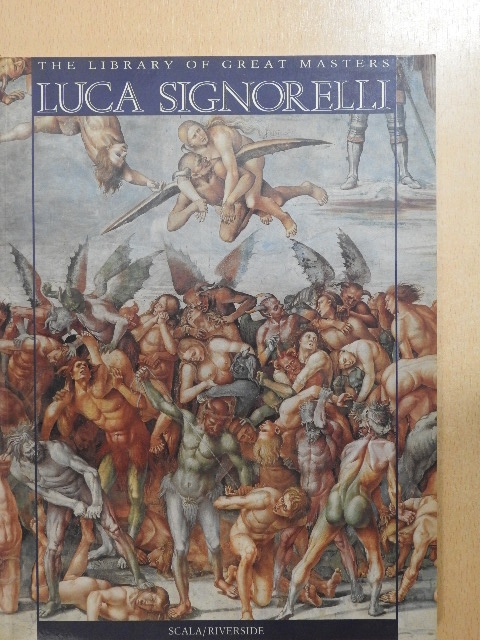
Cím: Luca Signorelli [antikvár]
Szerző:
Antonio Paolucci
Kiadó: Scala/Riverside
Kötés: Fűzött papírkötés
ISBN: 1878351125
Méret: 210 mm x 280 mm
Új vásárló vagyok!
új vásárlóval indíthatsz rendelést............