


kategória
szerző
cím
sorozat
betöltés...
kiadó
betöltés...
ISBN
évszám
ár
-
leírás
Előrendelhető
A mezők bármelyike illeszkedjen
A mezők mind illeszkedjen


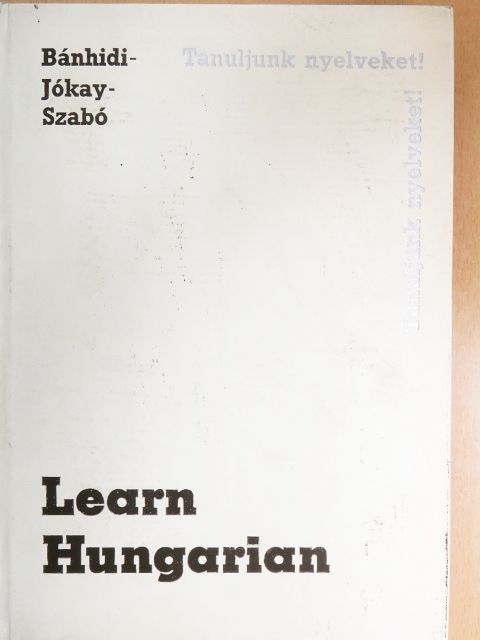
Learn Hungarian [antikvár]
Bánhídi Zoltán, Dénes Szabó, Jókay Zoltán, Szabó Dénes, Zoltán Bánhidi, Zoltán Jókay

PREFACE
Hungarian belongs to the Finno-Ugrian family of languages. It therefore differs in both grammatical structure and vocabulary from the other European tongues which belong for the most part to the vast Indo-European group of languages. Our language has been enriched through words borrowed not only from Slav and German speaking peoples who for more than a thousand years have been our neighbours, but from Latin too, the "lingua franca" of the Church and learning in the Middle Ages. Hungarian has maintained, however, its ancient...
online ár:
Webáruházunkban a termékek mellett feltüntetett fekete színű online ár csak internetes megrendelés esetén érvényes.
6040 Ft

Részletesen erről a termékről
Bővebb ismertető
PREFACE
Hungarian belongs to the Finno-Ugrian family of languages. It therefore differs in both grammatical structure and vocabulary from the other European tongues which belong for the most part to the vast Indo-European group of languages. Our language has been enriched through words borrowed not only from Slav and German speaking peoples who for more than a thousand years have been our neighbours, but from Latin too, the "lingua franca" of the Church and learning in the Middle Ages. Hungarian has maintained, however, its ancient Finno-Ugrian character, which is quite clear in the grammatical structure.
In this book we have paid special attention to the grammar of Hungarian. It has been written for students who already possess the elements of general grammatical knowledge and we have tried to explain the grammatical phenomena and to point out the most striking differences between English and Hungarian.
We cannot promise that the student will find Hungarian an easy language to learn. The aim of the book is to build up the student's knowledge step by step and the grammatical phenomena are explained as fully as possible. The book provides a comprehensive guide to those who are prepared to make a serious effort to learn Hungarian. The method used, however, demands longer and more detailed chapters on grammar than one usually finds in popular language tutors.
The reading exercises combine vocabulary in everyday use with selected points of grammar. Each lesson requires about six to eight hours' work and with continuous daily study the book can be finished within a year. This time can be varied at the student's discretion.
The proverbs, folk songs and jokes form an integral part of the book. It is essential that the exercises should be carefully written out since they are designed to consolidate the student's knowledge. Good results can only be achieved by constant repetition.
The book is intended for the use of teachers of Hungarian and for private study. A key to the exercises is provided on page 433 for students who intend to teach themselves.
After working carefully through this book the student should be able to speak and to write simple but idiomatic Hungarian and to read original texts.
The authors are greatly obliged to Mr. Michael Branch, B. A. (Richmond) who made many useful grammatical and stylistical corrections in the English text. Further they thank Dr. G. J. Gushing (University of London) and Prof. John Lötz (Columbia University, New York) for their valuable suggestions and advice referring to the grammatical rules and terminology.
Termékadatok
Cím: Learn Hungarian [antikvár]
Kiadó: Tankönyvkiadó Vállalat
Kötés: Fűzött keménykötés
Méret: 170 mm x 240 mm
Új vásárló vagyok!
új vásárlóval indíthatsz rendelést............