


kategória
szerző
cím
sorozat
betöltés...
kiadó
betöltés...
ISBN
évszám
ár
-
leírás
Előrendelhető
A mezők bármelyike illeszkedjen
A mezők mind illeszkedjen


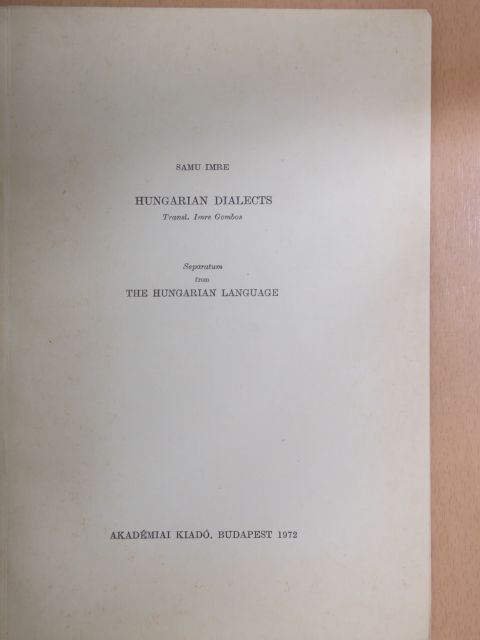

HUNGARIAN DIALECTS
by
SAMU IMRE INTRODUCTION
As early as the sixteenth century, Hungarian historiographers and grammarians made references and occasional remarks which indicate that some of them had noticed dialectal differences in the pronunciation, grammar, and vocabulary of Hungarian during this relatively early cultural phase. Nevertheless, a really profound interest in Hungarian dialects only asserted itself during the second half of the eighteenth century. Even then the study of dialects was not primarily connected with hnguistic...
online ár:
Webáruházunkban a termékek mellett feltüntetett fekete színű online ár csak internetes megrendelés esetén érvényes.
1980 Ft

Részletesen erről a termékről
Bővebb ismertető
HUNGARIAN DIALECTS
by
SAMU IMRE INTRODUCTION
As early as the sixteenth century, Hungarian historiographers and grammarians made references and occasional remarks which indicate that some of them had noticed dialectal differences in the pronunciation, grammar, and vocabulary of Hungarian during this relatively early cultural phase. Nevertheless, a really profound interest in Hungarian dialects only asserted itself during the second half of the eighteenth century. Even then the study of dialects was not primarily connected with hnguistic research but was, rather, motivated by social-political aspirations or economic factors with which contemporary literary trends were as closely allied in Hungary as they were in many other parts of Europe. In reaction to the Germanizing policy of the Hapsburgs in Hungary, the ideas of the Enlightenment were deeply intertwined with the national movements which strove, among other tilings, for a polished and refined Hungarian tongue and for a literary revival. All these circumstances favourably influenced the development of the Hungarian language, bringing about a transformation which was sometimes artificial in nature and sometimes forced in its methods but which was, at the same time, definitely positive as regards its final results: it was called the Language Reform Movement. The advocates of this reform had readily drawn from the dialects while their antagonists also referred to the popular idiom, especially when criticizing some of the curious and irregular word-formations ofthe neologists. As a result, a rich vocabulary of dialectal data was accumulated which was published by the Hungarian Academy of Sciences, 1838, entitled Magyar Tájszótár (Hungarian Dialect Dictionary).
The collection of dialectal words did not, of course, come to an end with this publication. A remarkable upswing ensued in 1872, when the periodical Magyar Nyelvőr (Hungarian Purist) was launched. More and more linguists joined the enthusiastic legion of collectors for the periodical, and besides collecting single items, they also published studies and monographs on dialects in increasing number, employing up-to-date scientific methods. The material collected during this period was published in the Magyar Tájszótár (Hungarian Dialect Dictionary) by József Szinnyei (1893 — 1901). The same decade also produced the first comprehensive work on Hungarian dialects: A magyar nyelvjárásoh osztályozása és jellemzése (Classification and Characterization of Hungarian Dialects) by József Balassa (1891).
The main approach to linguistic problems in Hungary between the two world wars was historical. The investigation of dialects was therefore rather neglected. Yet, two comprehensive works were published in the inter-war period: A magyar nyelvjárások (Hungarian Dialects) by Antal Horger
299
Termékadatok
Cím: Hungarian Dialects [antikvár]
Kiadó: Akadémiai Kiadó
Kötés: Tűzött kötés
Méret: 170 mm x 240 mm
Új vásárló vagyok!
új vásárlóval indíthatsz rendelést............