


kategória
szerző
cím
sorozat
betöltés...
kiadó
betöltés...
ISBN
évszám
ár
-
leírás
Előrendelhető
A mezők bármelyike illeszkedjen
A mezők mind illeszkedjen



PREFACE
The major ideas presented in this collection of papers comprise basic concepts which are crucial to the progressive development of health services anywhere in the world. This is the work of a remarkable physician—a man who combined his ability for keen theoretical analysis with the will to develop and administer programs of action which gave life to these ideas and demonstrated their soundness and promise. It is this combination of rigorous analysis and passionate advocacy that makes these papers, and the man who wrote them, so...
online ár:
Webáruházunkban a termékek mellett feltüntetett fekete színű online ár csak internetes megrendelés esetén érvényes.
9600 Ft

Részletesen erről a termékről
Bővebb ismertető
PREFACE
The major ideas presented in this collection of papers comprise basic concepts which are crucial to the progressive development of health services anywhere in the world. This is the work of a remarkable physician—a man who combined his ability for keen theoretical analysis with the will to develop and administer programs of action which gave life to these ideas and demonstrated their soundness and promise. It is this combination of rigorous analysis and passionate advocacy that makes these papers, and the man who wrote them, so unique and significant.
The reputation of John B. Grant is that of a thinker and a doer in the health field—and it is a reputation that is world wide. A member of the staff of The Rockefeller Foundation for forty-two years, he spent two-thirds of this time on loan to other organizations where he had operating responsibilities in various fields of public health, medical education and community planning. His responsibilities took him to all parts of the world. Also, they gave him the opportunity to amplify his understanding of the social context in which health services were to be developed. He was not satisfied simply to feel that his theoretical formulations were soundly based. He tested his ideas through reducing them to specific programs which he would then proceed to implement.
The organization of his papers in this coUection by Conrad Seipp, his student and colleague in recent years in Puerto Rico, sets forth the three leitmotifs of Grant's philosophy and life's work. The first is regionalization as the rational administrative framework for the organization and integration of the total effort involved in health services. The second is the need and the mechanisms required for education for the health professions within the context of community health care as a preparation for the most effective functioning of the health professions. The third mainstream which nurtured Grant's work is the principle that the planning and development of health services be considered as part of the process of community development, the latter being a multiphase activity involving health, welfare, economic, and social services, all of which are closely related
Termékadatok
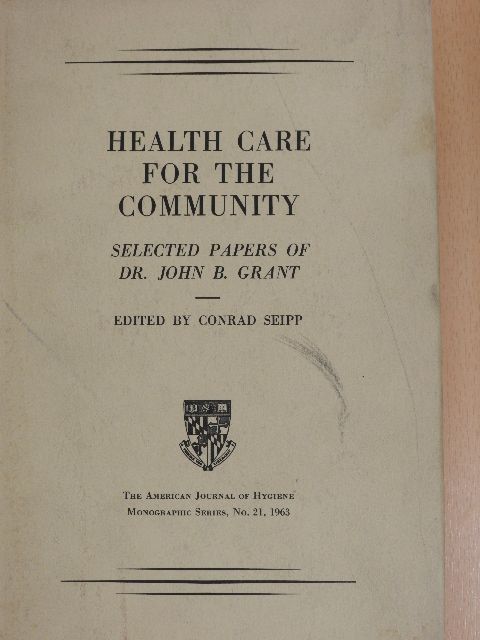
Cím: Health Care for the Community [antikvár]
Szerző:
Dr. John B. Grant
Kiadó: The Johns Hopkins Press
Kötés: Vászon
Méret: 160 mm x 230 mm
Új vásárló vagyok!
új vásárlóval indíthatsz rendelést............