


kategória
szerző
cím
sorozat
betöltés...
kiadó
betöltés...
ISBN
évszám
ár
-
leírás
Előrendelhető
A mezők bármelyike illeszkedjen
A mezők mind illeszkedjen


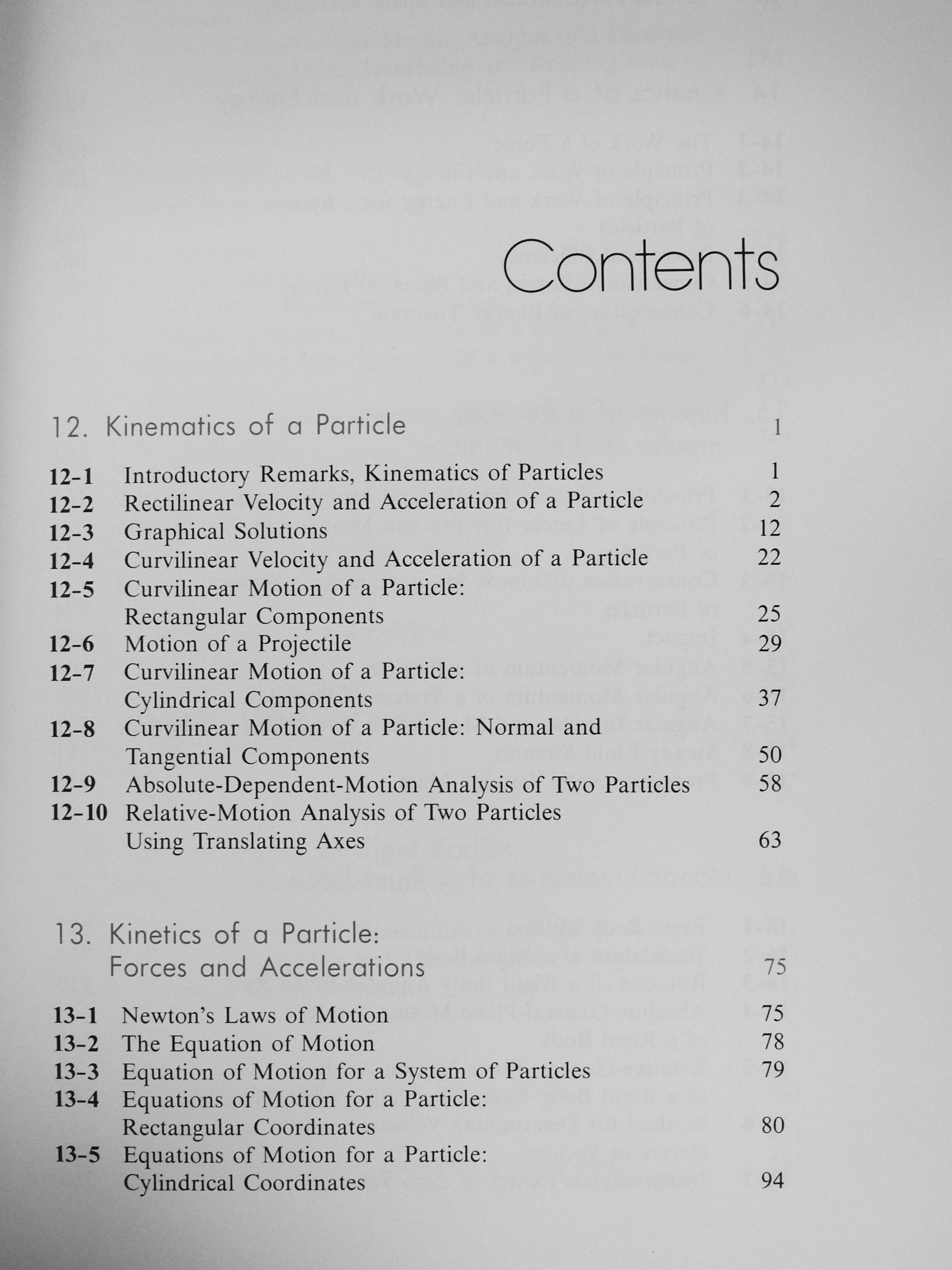

Kinematics ot a Particle
12-1. Introductory Remarks, Kinematics of Particles
Engineering mechanics consists of a study of both statics and dynamics. Statics deals with the equilibrium of bodies at rest or moving with constant velocity, whereas dynamics deals with bodies having accelerated motion. In general, dynamics is more complicated than statics, since the forces acting on the body must be related to the body's acceleration. The subject of dynamics is usually divided into two parts: (1) kinematics is concerned with the geometrical...
online ár:
Webáruházunkban a termékek mellett feltüntetett fekete színű online ár csak internetes megrendelés esetén érvényes.
12000 Ft

Részletesen erről a termékről
Bővebb ismertető
Kinematics ot a Particle
12-1. Introductory Remarks, Kinematics of Particles
Engineering mechanics consists of a study of both statics and dynamics. Statics deals with the equilibrium of bodies at rest or moving with constant velocity, whereas dynamics deals with bodies having accelerated motion. In general, dynamics is more complicated than statics, since the forces acting on the body must be related to the body's acceleration. The subject of dynamics is usually divided into two parts: (1) kinematics is concerned with the geometrical aspects of motion, and (2) kinetics is concerned with the analysis of the forces causing the motion. For simplicity in presenting the theory of both kinematics and kinetics, particle dynamics will be discussed first, followed by topics in rigid-body dynam-
Particle Motion. Recall that a particle is defined as a small portion of matter such that its dimension or size is of no consequence in the analysis of a physical problem. In most problems encountered, one is interested in bodies of a finite size, such as rockets, projectiles, or vehicles. Such objects may be considered as particles, provided motion of the body is characterized by motion of its mass center and any rotation of the body can be neglected.
In general, the "kinematics" of a particle is characterized by specifying the particle's displacement, velocity, and acceleration. This chapter begins with the study of the absolute motion of a particle, which is motion measured with respect to a fixed coordinate system. In this regard, motion along a straight line will be studied before introducing the more general motion along a curved path. Afterwards, the relative motion between two particles will be considered, using a translating coordinate system.
Termékadatok
Cím: Dynamics [antikvár]
Szerző:
R. C. Hibbeler
Kiadó: Macmillan Publishing Co.
Kötés: Fűzött keménykötés
ISBN: 0023540400
Méret: 210 mm x 240 mm
Új vásárló vagyok!
új vásárlóval indíthatsz rendelést............