


kategória
szerző
cím
sorozat
betöltés...
kiadó
betöltés...
ISBN
évszám
ár
-
leírás
Előrendelhető
A mezők bármelyike illeszkedjen
A mezők mind illeszkedjen


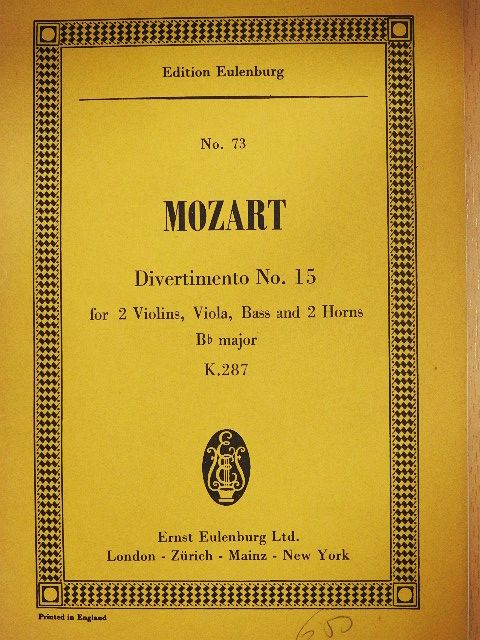

W. A. MOZART DIVERTIMENTO No. 15 (Koechel No. 287)
The Divertimento in B fiat major for string quartet and two horns, here published in a new edition, was composed by Mozart (according to a marginal note by the publisher J. André on the autograph score) in February, 1777, in Salzburg, half a year before the journey to Mannheim and Paris, so important for the young master. Il was, like its slightly older companion, the P major Divertimento K. 247, designated for the Countess Antónia Lodron and holds an important position in Mozart's...
online ár:
Webáruházunkban a termékek mellett feltüntetett fekete színű online ár csak internetes megrendelés esetén érvényes.
3680 Ft

Részletesen erről a termékről
Bővebb ismertető
W. A. MOZART DIVERTIMENTO No. 15 (Koechel No. 287)
The Divertimento in B fiat major for string quartet and two horns, here published in a new edition, was composed by Mozart (according to a marginal note by the publisher J. André on the autograph score) in February, 1777, in Salzburg, half a year before the journey to Mannheim and Paris, so important for the young master. Il was, like its slightly older companion, the P major Divertimento K. 247, designated for the Countess Antónia Lodron and holds an important position in Mozart's artistic development. As "Divertimento" il belongs to the closer sphere of the sonata-like chamber music, although the number of 6 movements and the twofold occurence of the Minuet point to its intermediary position between suite and sonata. The inner structure shows all the clearer that il was with the problems of the genuine sonata-like chamber music that Mozart was dealing in this instance. It may therefore be regarded as a certain amount of nonchalance that Mozart himself writes in a letter dated 3rd October, 1777, referring to this and the other above mentioned Divertimento as the " two caasazione for the Countess", and thai Leopold Mozart terms these works as the two "Lodron noctumos". Caasazione and serenade was at that time essentially the term (or No. 73
open-air music pieces, but according to technique and content this is by no means the case in this instance. It must however be admitted that Mozart's earlier Divertimenti (before Koechel 247) still demonstrate to a high degree the character of the nocturno as il appears in his serenades and caasazione. In the F major divertimento Koechel 247 of 1776, and thé present one in B flat major, Koechel 287, of the following year, Mozart has however commenced in transforming the category of divertimento from its serenade likeness to chamber music — a process which reached finality in the late Trio-Diverti-mento in E flat major, Koechel 563, of 1788. Hence it is quite plausible that at the time when this transformation of the older divertimento-type began to take shape Oust in 1777) Mozart still regarded divertimento and nocturno (caasazione, serenade) as equals.
The two French Mozart scholars, T. de Wyzewa and Q. de Saint-Foix, stress the contention that in the present divertimento in Bt Mozart had been guided to a farreaching extent by a string quintet of his Salzburg colleague Michael Haydn and had imitated certain stylistic peculiarities he had found therein (coda construction in the 1st movement, echo the-matics in the 2nd minuet, inslnunenlal
B.B.1I73
Termékadatok
Cím: Divertimento No. 15 [antikvár]
Szerző:
Wolfgang Amadeus Mozart
Kiadó: Ernst Eulenburg Ltd.
Kötés: Tűzött kötés
Méret: 140 mm x 190 mm
Új vásárló vagyok!
új vásárlóval indíthatsz rendelést............