


kategória
szerző
cím
sorozat
betöltés...
kiadó
betöltés...
ISBN
évszám
ár
-
leírás
Előrendelhető
A mezők bármelyike illeszkedjen
A mezők mind illeszkedjen


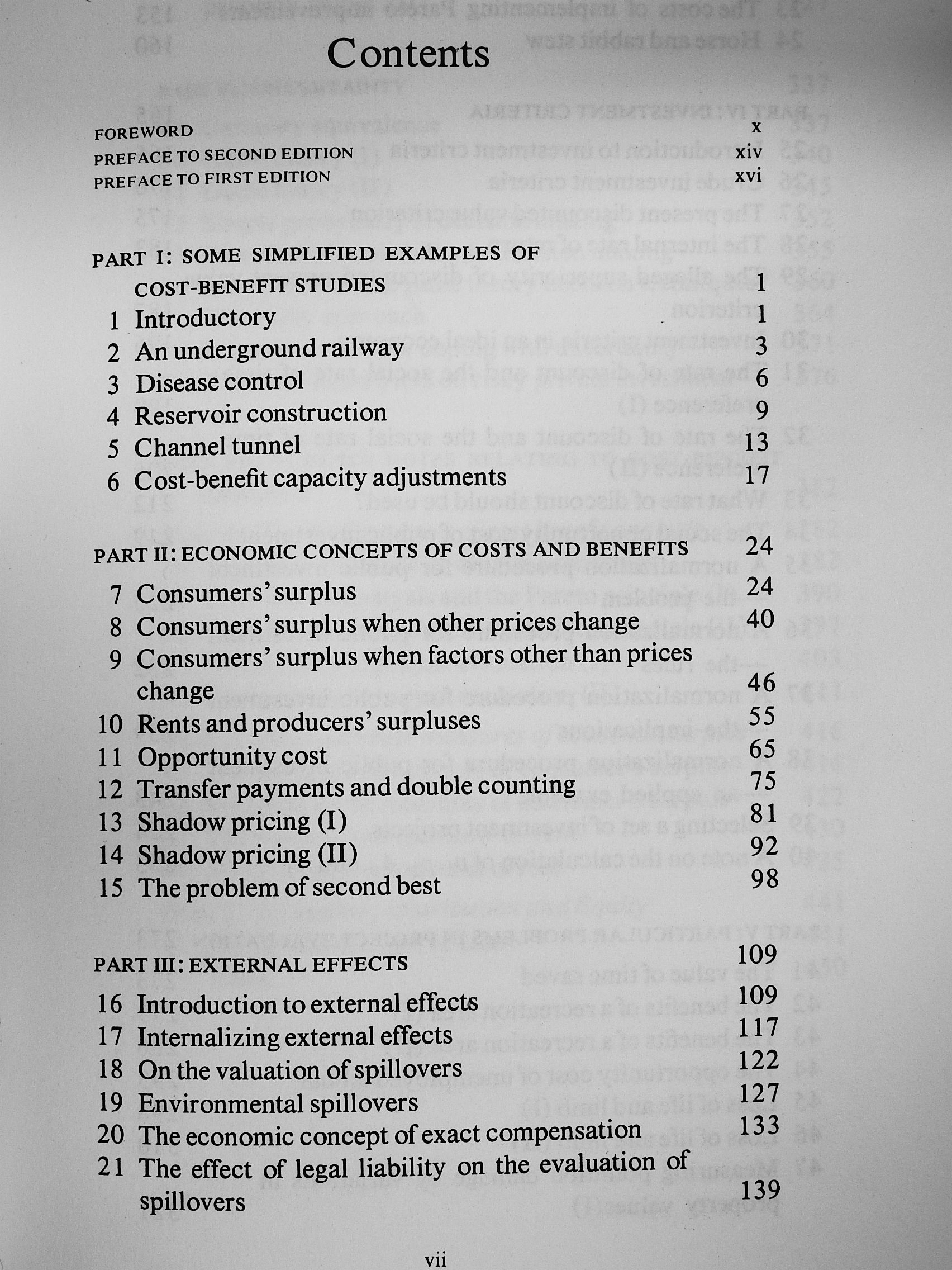

Foreword
1 The general question that a cost-benefit analysis sets out to answer s wLther a number of investment projects, A B, C, etc., should be undertaken and, if investible funds are limited, which one, two, or Lre, among these specific projects that would otherwise quaWy for admi!sion, should be selected. Another question to which cost-benefit analysis sometimes addresses itself is that of determming the level at which a plant should operate or the combination of outputs it should produce. In this introductory volume, however, we follow...
online ár:
Webáruházunkban a termékek mellett feltüntetett fekete színű online ár csak internetes megrendelés esetén érvényes.
2980 Ft

Részletesen erről a termékről
Bővebb ismertető
Foreword
1 The general question that a cost-benefit analysis sets out to answer s wLther a number of investment projects, A B, C, etc., should be undertaken and, if investible funds are limited, which one, two, or Lre, among these specific projects that would otherwise quaWy for admi!sion, should be selected. Another question to which cost-benefit analysis sometimes addresses itself is that of determming the level at which a plant should operate or the combination of outputs it should produce. In this introductory volume, however, we follow custom in confining our attention chiefly to the former question, about the choice
of investment projects.
But why bother with cost-benefit analysis at all? What is wrong with deciding whether or not to undertake any specific investment, or to choose among a number of specific investment opportunities, guided simply by proper accounting practices and, therefore, guided ultimately by reference to profitability. The answer is provided by the familiar thesis that what counts as a benefit or a loss to one part ofthe economy—to one or more persons or groups—does not necessarily count as a benefit or loss to the economy as a whole. And in cost-benefit analysis we are concerned with the economy as a whole, with the welfare of a defined society, and not any smaller part of it.
A private enterprise, or even a public enterprise, comprises only a segment ofthe economy, often a very small segment. More important, whatever the means it employs in pursuing its objectives—whether rules of thumb or more formalized techniques such as mathematical programming or operations research—the private enterprise, at least, IS guided by ordinary commercial criteria that require revenues to
Tnwv glided by the profit motive,
Sovees on ^h^^^holders. It also confers benefits on its
XZZluc '' ^"^-through the taxes it pays-on the
general public. Yet the benefits enjoyed by these four grLps continue
Termékadatok
Cím: Cost-Benefit Analysis [antikvár]
Szerző:
E. J. Mishan
Kiadó: George Allen&Unwin Ltd.
Kötés: Ragasztott papírkötés
ISBN: 0043380808
Méret: 140 mm x 210 mm
Új vásárló vagyok!
új vásárlóval indíthatsz rendelést............