


kategória
szerző
cím
sorozat
betöltés...
kiadó
betöltés...
ISBN
évszám
ár
-
leírás
Előrendelhető
A mezők bármelyike illeszkedjen
A mezők mind illeszkedjen


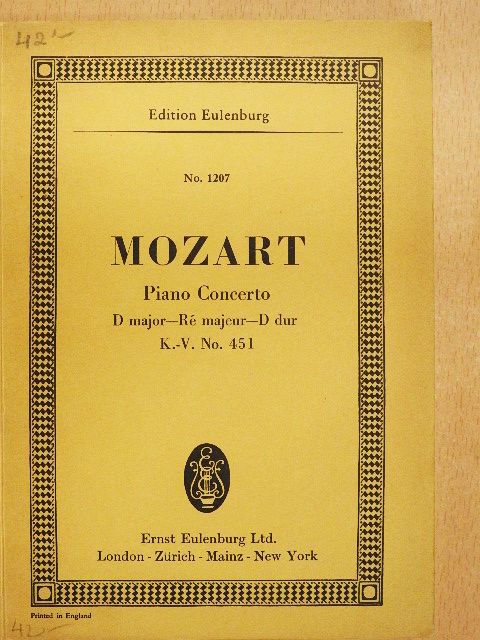
Concerto D major for Pianoforte and Orchestra [antikvár]
Wolfgang Amadeus Mozart

Ill
Mozart's Piano Concerto in D Major, 1784 Koechel No. 451
The Concerto in D is the second of a group of three Piano Concertos which follow K.449, completed on February 9, 1784. They were composed between that date and April 12, 1784, when the Concerto in G, Koechel No. 453, was completed. Of the three (Koechel Nos. 450, 451, 453) the last one—like Koechel 449—was expressly written for Mozart's pupil Babette Ployer. However, the two twin Concertos of the group— Koechel 450 and 451—completed on March 15 and 22, 1784, Mozart...
online ár:
Webáruházunkban a termékek mellett feltüntetett fekete színű online ár csak internetes megrendelés esetén érvényes.
4580 Ft

Részletesen erről a termékről
Bővebb ismertető
Ill
Mozart's Piano Concerto in D Major, 1784 Koechel No. 451
The Concerto in D is the second of a group of three Piano Concertos which follow K.449, completed on February 9, 1784. They were composed between that date and April 12, 1784, when the Concerto in G, Koechel No. 453, was completed. Of the three (Koechel Nos. 450, 451, 453) the last one—like Koechel 449—was expressly written for Mozart's pupil Babette Ployer. However, the two twin Concertos of the group— Koechel 450 and 451—completed on March 15 and 22, 1784, Mozart composed for himself. This is born out by a passage of the letter to his father, dated May 15, 1784, in which he emphasizes that no one but himself "possesses these new Concertos in B flat and D". In a later letter to his father, of May 26, 1784, he refers again to these "twins" conjunctly thus: " I am unable to choose between the two Concertos; I believe both are capable to make one perspire. However as regards technical difficulty ¦ the Concerto in B flat is superior to the one in D. . . . Well, I am anxious to know which one of the three in B flat (K.450), in D (K.451) and G (K.453) you and my sister like most. . . . I'd like to know if her verdict will coincide with the general as well as with my own opinion of them; of course it is necessary to perform all three Concertos with their complete parts and with care. . . ."
Evidently Mozart tliought highly of this group of "grand Concertos", written for a much bigger orchestra than the early Vienna Concertos, Koechel Nos. 413-415, which could also, be performed "a quattro", i.e. as Piano Quintets (Cf. Mozart's letter to the publisher Sieber, of April 26, 1783, reprinted in the original in the German version of the preface to my edition of K.414, Edition Euienburg, No. 800).
Among the three Concertos, referred to above, K.451 requires the largest orchestral force. With its one Flute, and its two Oboes, Bassoons, Horn, Trumpets, Timpani and Strings it even outnumbers the orchestra of K.415, the only other Piano Concerto" of Mozart's early years in Vieima, conceived almost on the lines of a symphony. K.451 also shares with K.415 the fanfare-like
march-rhythm:
j rs j j
of its
truly majestic first movement and the oddity of a concluding 3/4 section at the end of its Rondo-Finale in 2/4 metre. The noisy, somewhat operatic, Overture-style of the beginning of the first movement is probably responsible for the poor opinion some scholars entertain of this Concerto in general. The many felicitous touches of its boldly modulating development-section should have warned them not to become dupes of Mozart's occasional mock-conven-tionalities. The slow movement with its "Romanza" character however differs structurally from the lyricism of the respective middle movement in K.415. It is really a Rondo whose nostalgically chromatic principal subject recurs three times, interrupted by beautiful episodes in D, E and C and finally concluded by a variational Coda in the tonic. It was this "Andante" to which Mozart's sister erroneously referred to as an "Adagio", only to be corrected by the composer in a letter of June 9(12), 1784. That letter contains a reply to her justifiable criticism of certain "all too bare" portions of the movement. (It was the episode in C major with its thin accompaniment in the left hand.) In deference to her wishes Mozart supplied an ornamented variant of the passage the Autograph of which has been preserved in the Benedictine foundation of St.
E.E. 6066
Termékadatok
Cím: Concerto D major for Pianoforte and Orchestra [antikvár]
Szerző:
Wolfgang Amadeus Mozart
Kiadó: Ernst Eulenburg
Kötés: Varrott papírkötés
Méret: 140 mm x 190 mm
Új vásárló vagyok!
új vásárlóval indíthatsz rendelést............