


kategória
szerző
cím
sorozat
betöltés...
kiadó
betöltés...
ISBN
évszám
ár
-
leírás
Előrendelhető
A mezők bármelyike illeszkedjen
A mezők mind illeszkedjen


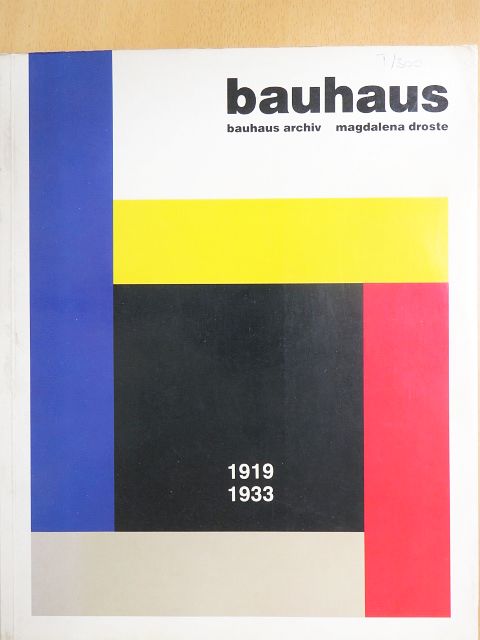

Preface
Seventy years after its foundation in Weimar, the Bauhaus has become a concept, indeed a catchphrase all over the world. The respect which it commands is associated above all with the design it pioneered, one which we now describe - with inadmissible simplism - as 'Bauhaus style'. The teachers at the Bauhaus acquired legendary fame and included the leading artists of the times, among them Wassily Kandinsky, Lyonel Feininger, Paul Klee and Oskar Schlemmer. The teaching strategies developed at the Bauhaus, in particular by Johannes...
online ár:
Webáruházunkban a termékek mellett feltüntetett fekete színű online ár csak internetes megrendelés esetén érvényes.
7480 Ft

Részletesen erről a termékről
Bővebb ismertető
Preface
Seventy years after its foundation in Weimar, the Bauhaus has become a concept, indeed a catchphrase all over the world. The respect which it commands is associated above all with the design it pioneered, one which we now describe - with inadmissible simplism - as 'Bauhaus style'. The teachers at the Bauhaus acquired legendary fame and included the leading artists of the times, among them Wassily Kandinsky, Lyonel Feininger, Paul Klee and Oskar Schlemmer. The teaching strategies developed at the Bauhaus, in particular by Johannes Itten, Josef Albers and László Moholy-Nagy, were adopted internationally into the curriculums of art and design institutes and are still flourishing today. On the other hand, the avant-garde Bauhaus architecture developed in the twenties in the works of Walter Gropius and Ludwig Mies van der Rohe, with its monotone box-like constructions and soulless housing estates, is today not infrequently blamed for the ugliness of our cities and the violation of our countryside. Simplifications, prejudices and misconceptions abound in reactions to the Bauhaus, a problem with which the Bauhaus itself had to contend even during the brief fourteen years of its existence. 'Bauhaus' became an abbreviation for the radical modernization of life and its positive and negative side-effects. The name stood for an entire programme, and the development and changing fortunes of the school were followed with widespread interest by supporters and critics alike.
The development of the Bauhaus unfolded more or less in tandem with the history of the first German Republic. Walter Gropius founded the Bauhaus in 1919 in Weimar, where the National Assembly had met to draw up a democratic constitution. Ludwig Mies van der Rohe, the last director of the Bauhaus, dissolved the school in Berlin in 1933, under heavy pressure from the National Socialists who had seized power just a few months before. The suppression of the institution was not, however, enough to contain the influence of the ideas it had stood for, particularly since some of the most important Bauhaus teachers subsequently rose to prominence outside Germany, and above all in the United States of America. Thus Walter Gropius and Marcel Breuer became architects and architecture teachers at Harvard University, and likewise Ludwig Mies van der Rohe in Chicago; Josef Albers continued his teaching career at Black Mountain College, while László Moholy-Nagy founded the 'New Bauhaus' in Chicago in 1937. Other Bauhaus members worked in various parts of Europe, the Soviet Union and the Middle East. Others again remained - more or less quietly-in Nazi Germany.
The attention which the Bauhaus continued to attract even after its official closure was a tribute to its achievements in the few years between 1919-1933. The developments of this period require detailed, differentiated examination, for the effects of the Bauhaus were felt in the most varying areas of design. The Bauhaus developed - not without contradictions -
6
Termékadatok
Cím: Bauhaus [antikvár]
Szerző:
Magdalena Droste
Kiadó: Benedikt Taschen Verlag GmbH
Kötés: Fűzött kemény papírkötés
ISBN: 3822876275
Méret: 250 mm x 300 mm
Új vásárló vagyok!
új vásárlóval indíthatsz rendelést............