


kategória
szerző
cím
sorozat
betöltés...
kiadó
betöltés...
ISBN
évszám
ár
-
leírás
Előrendelhető
A mezők bármelyike illeszkedjen
A mezők mind illeszkedjen


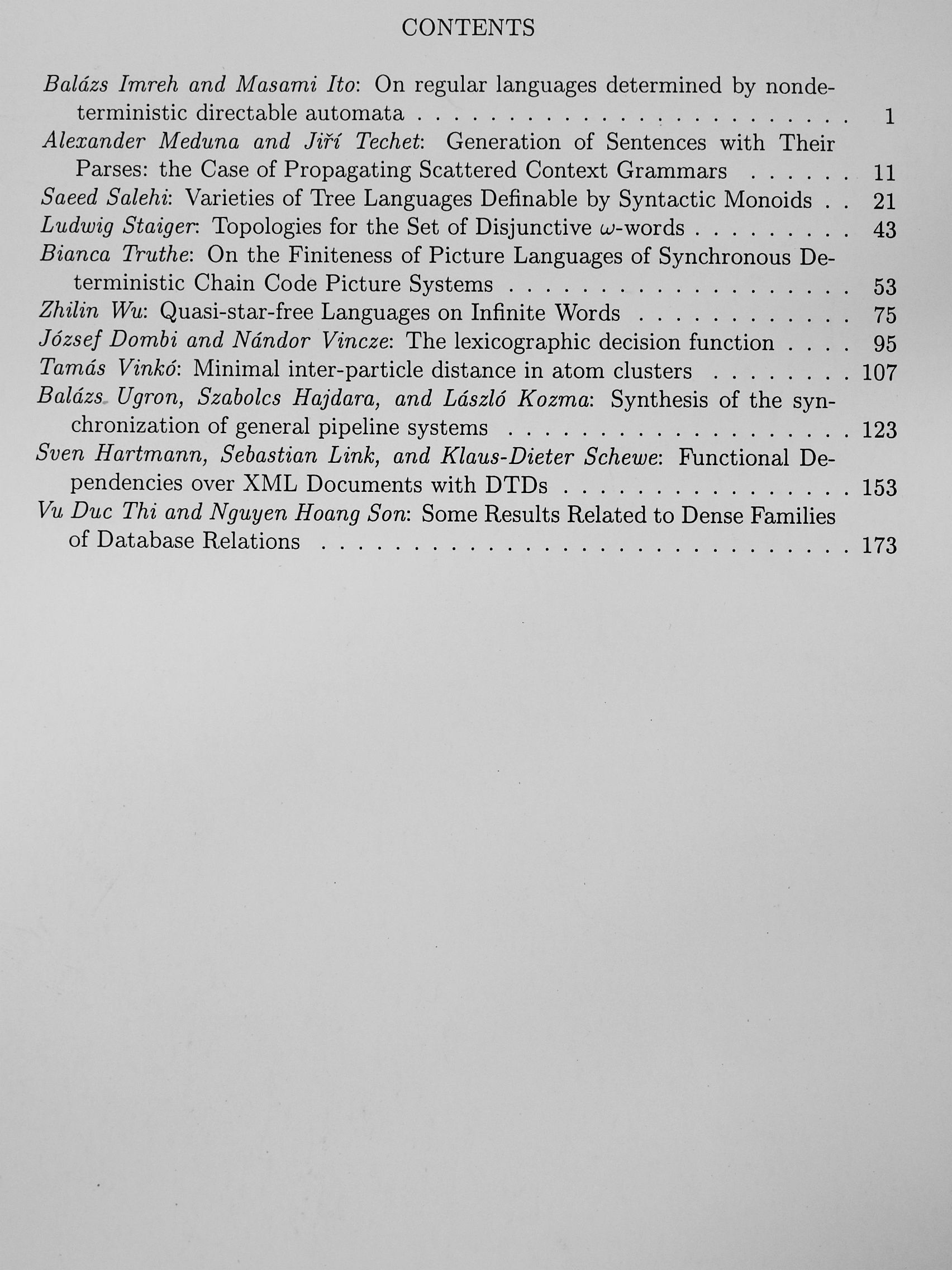
Acta Cybernetica 2005/1. [antikvár]
Alexander Meduna, Balázs Imreh, Imreh Balázs, Masami Ito

On regular languages determined by nondeterministic directable automata*
Balázs Imreh^ and Masami Ito^
Abstract
It is known that the languages consisting of directing words of deterministic 2ind nondeterministic automata Eire regular. Here these classes of regular languages are studied and compared. By introducing further three classes of regular languages, it is proved that the 8 classes considered form a semilattice with respect to intersection.
1 Introduction
We recall that an input word of an automaton is called directing or...
online ár:
Webáruházunkban a termékek mellett feltüntetett fekete színű online ár csak internetes megrendelés esetén érvényes.
1840 Ft

Részletesen erről a termékről
Bővebb ismertető
On regular languages determined by nondeterministic directable automata*
Balázs Imreh^ and Masami Ito^
Abstract
It is known that the languages consisting of directing words of deterministic 2ind nondeterministic automata Eire regular. Here these classes of regular languages are studied and compared. By introducing further three classes of regular languages, it is proved that the 8 classes considered form a semilattice with respect to intersection.
1 Introduction
We recall that an input word of an automaton is called directing or synchronizing if it brings the automaton from every state into the same state. An automaton is directable if it has a directing word. The directable automata and directing words have been studied from different points of view (see [2, 3, 5, 6, 7, 8, 10, 12, 13], for example). For nondeterministic (n.d.) automata, the directability can be defined in several ways. We study here three notions of directabihty which are defined in [7] as follows. An input word w of an n.d. automaton A is
(1) Dl-directing if the set of states aw in which A may be after reading w consists of the same single state c whatever the initial state a is;
(2) D2-directing if the set aw is independent of the initial state a;
(3) DS-directing if there exists a state c included in all sets aw.
We mention that Dl-directability of complete n.d. automata was already studied by Burkhard [1], where he gave an exact exponential bound for the length of minimum-length Dl-directing words of complete n.d. automata. In [5], classes of languages consisting of directing words of different types of n.d. automata were studied. Here, we extend our investigations to three further classes of languages and present some of their properties. The paper is organized as follows. The next
•This work has been supported by the Japanese Ministry of Education, Mombusho Internei-tional Scientific Research Program, Joint Research 10044098 and the Hungarian National Foundation for Scientific Research, Grant T037258.
'Dept. of Informatics, University, of Szeged, Árpád tér 2, H-6720 Szeged, Hungary 'Dept. of Mathematics, Faculty of Science, Kyoto Sangyo University, Kyoto 603-8555, Japan
Termékadatok
Cím: Acta Cybernetica 2005/1. [antikvár]
Kiadó: Institute of Informatics
Kötés: Ragasztott papírkötés
Méret: 170 mm x 240 mm
Új vásárló vagyok!
új vásárlóval indíthatsz rendelést............