


kategória
szerző
cím
sorozat
betöltés...
kiadó
betöltés...
ISBN
évszám
ár
-
leírás
Előrendelhető
A mezők bármelyike illeszkedjen
A mezők mind illeszkedjen


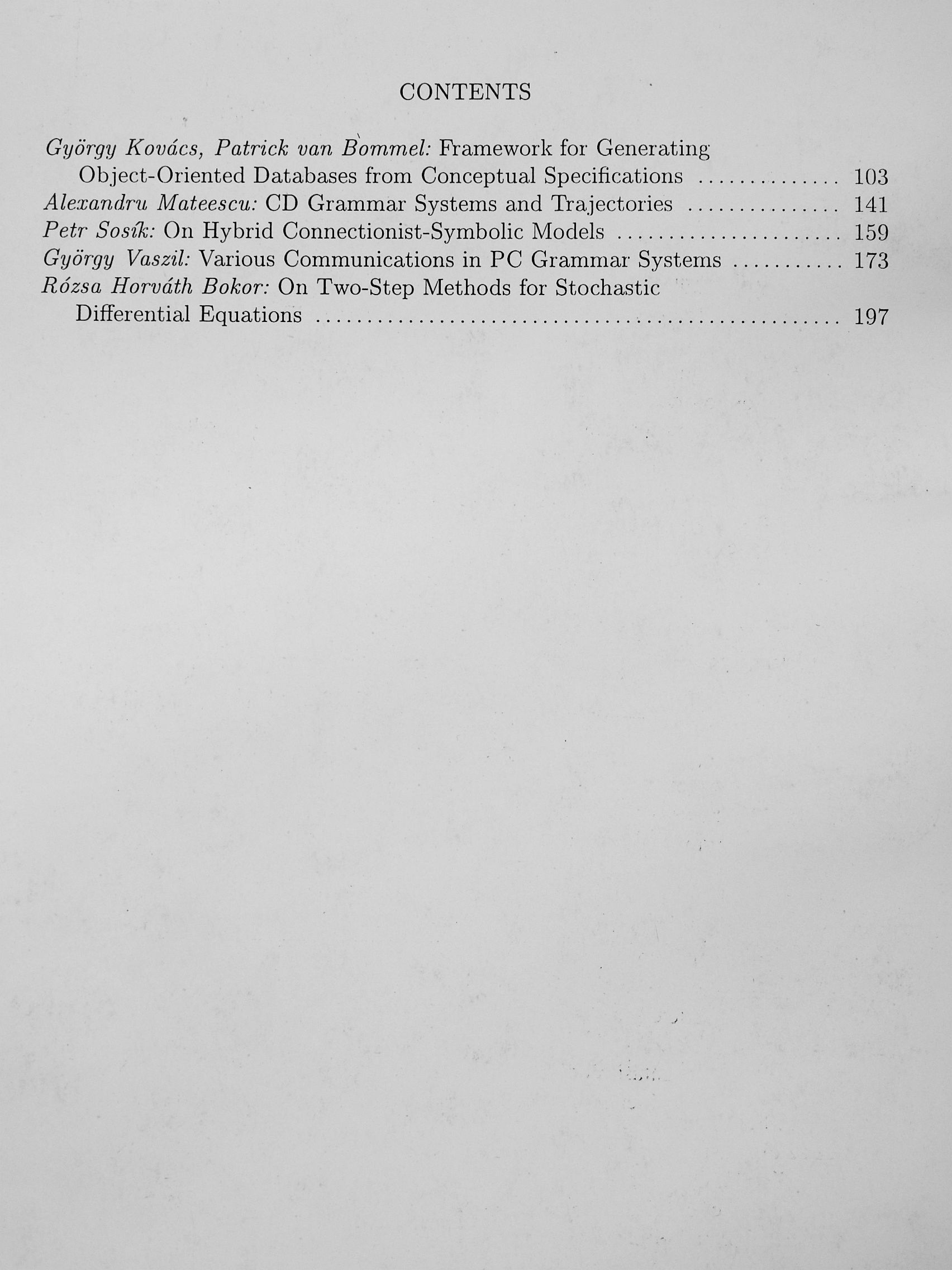
Acta Cybernetica 1997/2. [antikvár]
Alexandru Mateescu, György Kovács, Kovács György, Patrick van Bommel

Acta Cybernetica 13 (1997) 103-140.
Framework for Generating Object-Oriented Databases from Conceptual Specifications
György Kovács * Patrick van Bommel ^
Abstract
When designing underlying databases of information systems, data are first modelled on conceptual level, then the obtained conceptual data models are transformed to database schémas. The focus of this paper is the transformation of conceptual models into databcise systems with object-oriented features. The transformation is captured within the framework of a two lev(îl...
online ár:
Webáruházunkban a termékek mellett feltüntetett fekete színű online ár csak internetes megrendelés esetén érvényes.
1840 Ft

Részletesen erről a termékről
Bővebb ismertető
Acta Cybernetica 13 (1997) 103-140.
Framework for Generating Object-Oriented Databases from Conceptual Specifications
György Kovács * Patrick van Bommel ^
Abstract
When designing underlying databases of information systems, data are first modelled on conceptual level, then the obtained conceptual data models are transformed to database schémas. The focus of this paper is the transformation of conceptual models into databcise systems with object-oriented features. The transformation is captured within the framework of a two lev(îl architecture. Conceptual models are first mapped to abstract intermediate specifications, which are then transformed to database schémas in a given target environment. This enables us to treat different target systems, such as object-oriented and object-relational systems including the standards ODMG and SQL3, in a uniform way. To express intermediate representations of conceptual models we use F-logic, a logic-based abstract specification language for object-oriented systems. We focus on the first step of the overall transformation, i.e. the mapping of conceptual models into F-logic. Several tran.^-formation alternatives are discussed, and a corresponding graphical notation for specifying transformation alternatives is provided.
Keywords: database design, data transformation, conceptual data models, 00 models
Introduction
has been generally agreed on that conceptual data modelling is very important hen building information systems. This means that data must be modelled first :i conceptual level, and then the obtained conceptual model (conceptual schema) tust be translated to the external and internal level, according to the three level rchitecture for information systems modelling ([15]). By doing so, the issues of ^rrectness and efficiency are well-separated, which is quite desirable. In this paper e deal with the transformation of conceptual data models to the internal level.
'Department of Information Systems, Eötvös Loránd University, Múzeum krt. 6-8., H-1088 uclapest, Hungary, email: [email protected]. Supported by the Hungarian Scientific esearch Fund (OTKA W-015176) and Nuffic.
^Department of Information Systems, University of Nijmegen, Toernooiveld I, NL-6525 ED ijmegen. The Netherlands, email:[email protected]
103
f . i
ilr
. I
¦i ' i. ¦ / /
Termékadatok
Cím: Acta Cybernetica 1997/2. [antikvár]
Kiadó: Institute of Informatics
Kötés: Ragasztott papírkötés
Méret: 170 mm x 240 mm
Új vásárló vagyok!
új vásárlóval indíthatsz rendelést............