


kategória
szerző
cím
sorozat
betöltés...
kiadó
betöltés...
ISBN
évszám
ár
-
leírás
Előrendelhető
A mezők bármelyike illeszkedjen
A mezők mind illeszkedjen


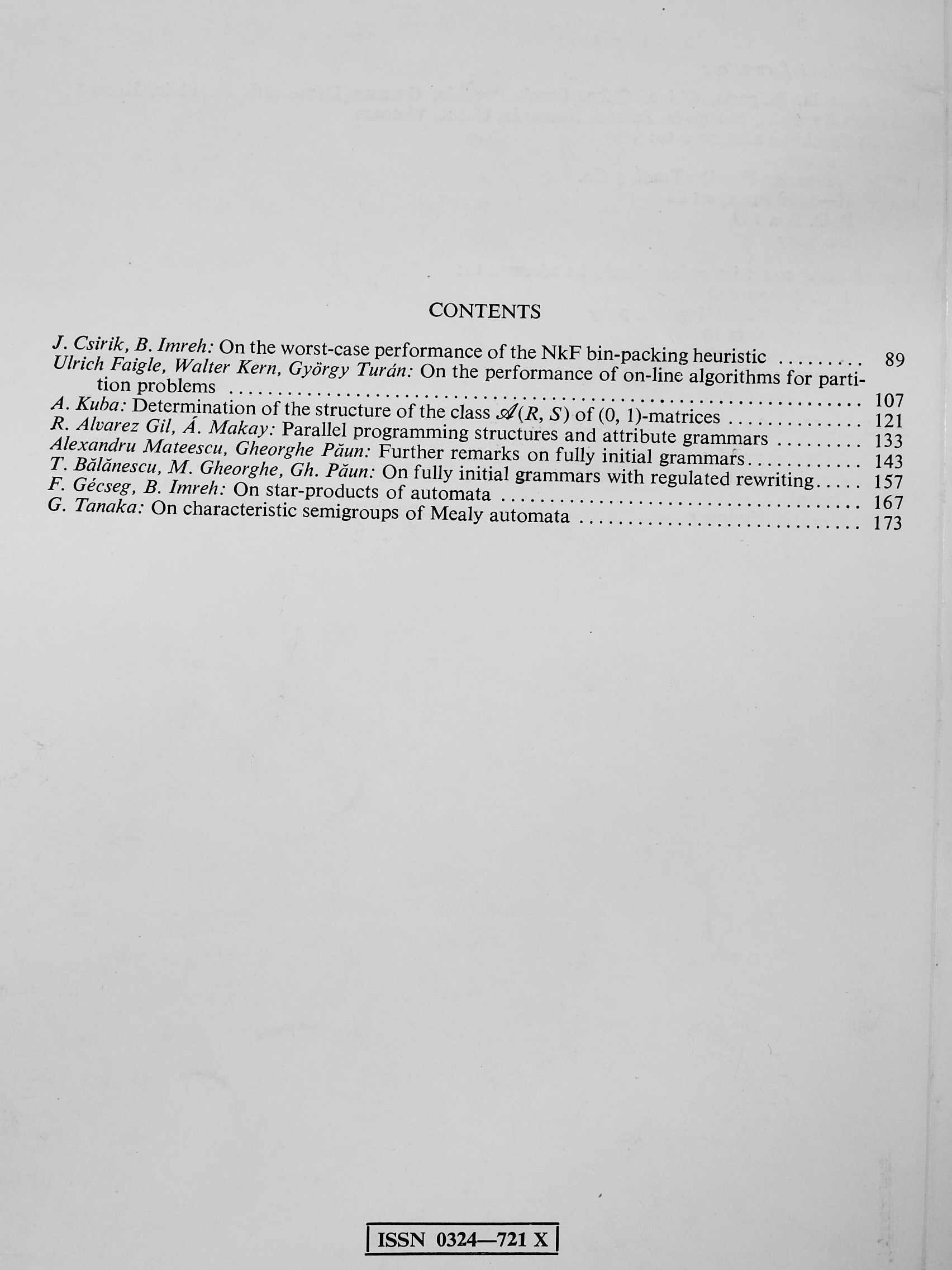
Acta Cybernetica 1989/2. [antikvár]
B. Imreh, Csirik J., Imreh B., J. Csirik, Ulrich Faigle

90 J. Csirik and B. Imreh
The asymptotic worst-case ratio of A is then defined as
RJ^ = limsup R^^.
Let
s{L)^ ZSi i=l
and let s(b,) denote the sum of the weights of the items in
We investigate the NkF algorithm, which is defined as follows: we always use k bins at the same time. If the next element, Oj, is coming, we place it into the first of the k used bins which has enough room for it. If no such bin has enough room, we close the first (oldest) of these k bins, open a new one, and put Oj into this bin (this will now be the ^-th or...
online ár:
Webáruházunkban a termékek mellett feltüntetett fekete színű online ár csak internetes megrendelés esetén érvényes.
1470 Ft

Részletesen erről a termékről
Bővebb ismertető
90 J. Csirik and B. Imreh
The asymptotic worst-case ratio of A is then defined as
RJ^ = limsup R^^.
Let
s{L)^ ZSi i=l
and let s(b,) denote the sum of the weights of the items in
We investigate the NkF algorithm, which is defined as follows: we always use k bins at the same time. If the next element, Oj, is coming, we place it into the first of the k used bins which has enough room for it. If no such bin has enough room, we close the first (oldest) of these k bins, open a new one, and put Oj into this bin (this will now be the ^-th or youngest bin).
Johnson has proved for the asymptotic worst-case ratio of NkF that
_3 lOyk
In this paper we prove that
•^JV2F = 2
and that for
However, vhe exact worst-case ratio is not known for
Results
First we give an upper bound on ii^vtr for Let L be an arbitrary list and
let us pack the elements of L by means of NkF. Let B^, B2, , B, denote the sequence of bins used and let w be a fixed nonnegative integer. For any positive integer ^r + i-m the sequence of the bins B,-, B.+j, , is called a parcel consisting
of m bins if the following conditions hold
0,)j(5,)>l/2 (i = /, ,i+m-l),
(b) i + m-l = or i+m-l < 7-&i(5j+„) ^ 1/2.
We classify the bins of a parcel consisting of m bins with respect to their contents as follows:
(A) Zi,^2/3&(3i)(i,>l/2),
(B) 1/2),
(C) Ii,<2/3&(3i)(j,>l/2),
(D)2:i,<2/3&(VO(.f,^ 1/2),
Termékadatok
Cím: Acta Cybernetica 1989/2. [antikvár]
Kiadó: Institute of Informatics
Kötés: Ragasztott papírkötés
Méret: 170 mm x 240 mm
Új vásárló vagyok!
új vásárlóval indíthatsz rendelést............