


kategória
szerző
cím
sorozat
betöltés...
kiadó
betöltés...
ISBN
évszám
ár
-
leírás
Előrendelhető
A mezők bármelyike illeszkedjen
A mezők mind illeszkedjen


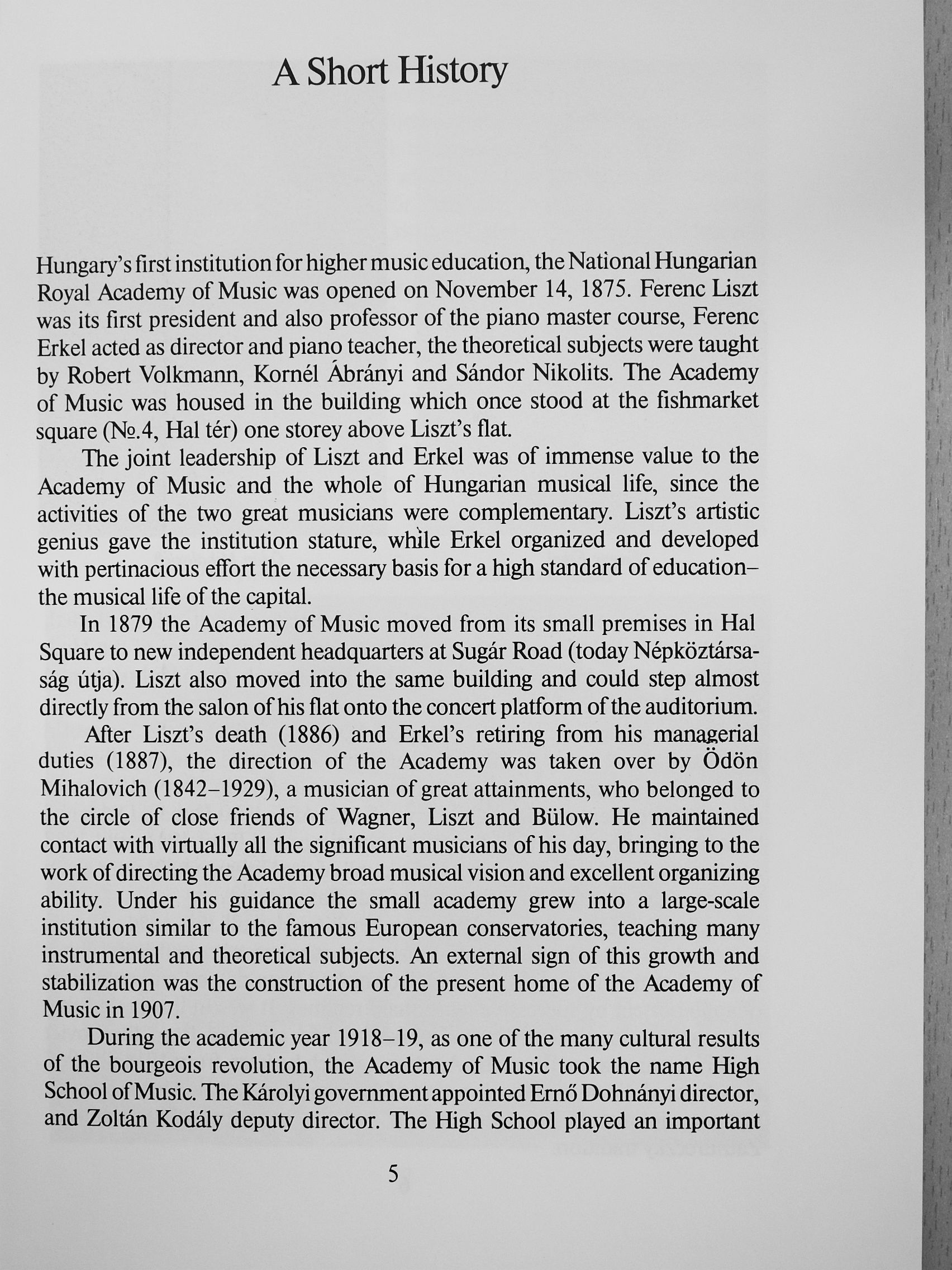

A Short History
Hungary's first institution for higher music education, the National Hungarian Royal Academy of Music was opened on November 14, 1875. Ferenc Liszt was its first president and also professor of the piano master course, Ferenc Erkel acted as director and piano teacher, the theoretical subjects were taught by Robert Volkmann, Kornél Ábrányi and Sándor Nikolits. The Academy of Music was housed in the building which once stood at the fishmarket square (N9.4, Hal tér) one storey above Liszt's flat.
The joint leadership of...
online ár:
Webáruházunkban a termékek mellett feltüntetett fekete színű online ár csak internetes megrendelés esetén érvényes.
940 Ft

Részletesen erről a termékről
Bővebb ismertető
A Short History
Hungary's first institution for higher music education, the National Hungarian Royal Academy of Music was opened on November 14, 1875. Ferenc Liszt was its first president and also professor of the piano master course, Ferenc Erkel acted as director and piano teacher, the theoretical subjects were taught by Robert Volkmann, Kornél Ábrányi and Sándor Nikolits. The Academy of Music was housed in the building which once stood at the fishmarket square (N9.4, Hal tér) one storey above Liszt's flat.
The joint leadership of Liszt and Erkel was of immense value to the Academy of Music and the whole of Hungarian musical life, since the activities of the two great musicians were complementary. Liszt's artistic genius gave the institution stature, while Erkel organized and developed with pertinacious effort the necessary basis for a high standard of education-the musical life of the capital.
In 1879 the Academy of Music moved from its small premises in Hal Square to new independent headquarters at Sugár Road (today Népköztársaság útja). Liszt also moved into the same building and could step almost directly from the salon of his flat onto the concert platform of the auditorium.
Aiter Liszt's death (1886) and Erkel's retiring from his managerial duties (1887), the direction of the Academy was taken over by Ödön Mihalovich (1842-1929), a musician of great attainments, who belonged to the circle of close friends of Wagner, Liszt and Bülow. He maintained contact with virtually all the significant musicians of his day, bringing to the work of directing the Academy broad musical vision and excellent organizing ability. Under his guidance the small academy grew into a large-scale institution similar to the famous European conservatories, teaching many instrumental and theoretical subjects. An external sign of this growth and stabilization was the construction of the present home of the Academy of Music in 1907.
During the academic year 1918-19, as one of the many cultural results of the bourgeois revolution, the Academy of Music took the name High School of Music. The Károlyi government appointed Ernő Dohnányi director, and Zoltán Kodály deputy director. The High School played an important
Termékadatok
Cím: Ferenc Liszt Academy of Music Budapest [antikvár]
Kötés: Ragasztott papírkötés
Méret: 160 mm x 240 mm
Új vásárló vagyok!
új vásárlóval indíthatsz rendelést............