


kategória
szerző
cím
sorozat
betöltés...
kiadó
betöltés...
ISBN
évszám
ár
-
leírás
Előrendelhető
A mezők bármelyike illeszkedjen
A mezők mind illeszkedjen


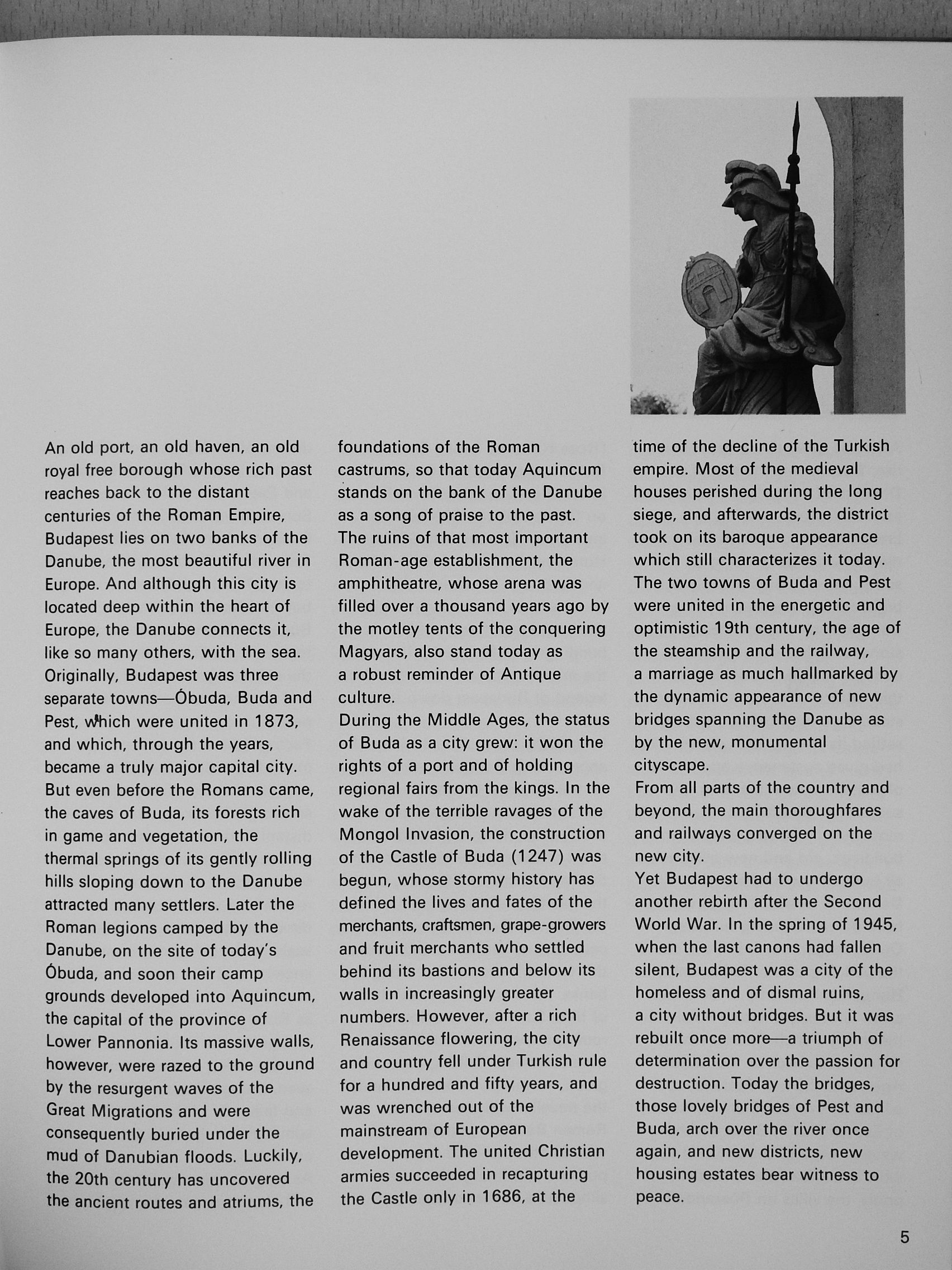

An old port, an old haven, an old royal free borough whose rich past reaches back to the distant centuries of the Roman Empire, Budapest lies on two banks of the Danube, the most beautiful river in Europe. And although this city is located deep within the heart of Europe, the Danube connects it, like so many others, with the sea. Originally, Budapest was three separate towns—Óbuda, Buda and Pest, wttiich were united in 1873, and which, through the years, became a truly major capital city. But even before the Romans came, the caves of...
online ár:
Webáruházunkban a termékek mellett feltüntetett fekete színű online ár csak internetes megrendelés esetén érvényes.
1640 Ft

Részletesen erről a termékről
Bővebb ismertető
An old port, an old haven, an old royal free borough whose rich past reaches back to the distant centuries of the Roman Empire, Budapest lies on two banks of the Danube, the most beautiful river in Europe. And although this city is located deep within the heart of Europe, the Danube connects it, like so many others, with the sea. Originally, Budapest was three separate towns—Óbuda, Buda and Pest, wttiich were united in 1873, and which, through the years, became a truly major capital city. But even before the Romans came, the caves of Buda, its forests rich in game and vegetation, the thermal springs of its gently rolling hills sloping down to the Danube attracted many settlers. Later the Roman legions camped by the Danube, on the site of today's Óbuda, and soon their camp grounds developed into Aquincum, the capital of the province of Lower Pannónia. Its massive walls, however, were razed to the ground by the resurgent waves of the Great Migrations and were consequently buried under the mud of Danubian floods. Luckily, the 20th century has uncovered the ancient routes and atriums, the
foundations of the Roman castrums, so that today Aquincum stands on the bank of the Danube as a song of praise to the past. The ruins of that most important Roman-age establishment, the amphitheatre, whose arena was filled over a thousand years ago by the motley tents of the conquering Magyars, also stand today as a robust reminder of Antique culture.
During the Middle Ages, the status of Buda as a city grew: it won the rights of a port and of holding regional fairs from the kings. In the wake of the terrible ravages of the Mongol Invasion, the construction of the Castle of Buda (1247) was begun, whose stormy history has defined the lives and fates of the merchants, craftsmen, grape-growers and fruit merchants who settled behind its bastions and below its walls in increasingly greater numbers. However, after a rich Renaissance flowering, the city and country fell under Turkish rule for a hundred and fifty years, and was wrenched out of the mainstream of European development. The united Christian armies succeeded in recapturing the Castle only in 1686, at the
time of the decline of the Turkish empire. Most of the medieval houses perished during the long siege, and afterwards, the district took on its baroque appearance which still characterizes it today. The two towns of Buda and Pest were united in the energetic and optimistic 19th century, the age of the steamship and the railway, a marriage as much hallmarked by the dynamic appearance of new bridges spanning the Danube as by the new, monumental cityscape.
From all parts of the country and beyond, the main thoroughfares and railways converged on the new city.
Yet Budapest had to undergo another rebirth after the Second World War. In the spring of 1945, when the last canons had fallen silent, Budapest was a city of the homeless and of dismal ruins, a city without bridges. But it was rebuilt once more—a triumph of determination over the passion for destruction. Today the bridges, those lovely bridges of Pest and Buda, arch over the river once again, and new districts, new housing estates bear witness to peace.
Termékadatok
Cím: Budapest [antikvár]
Kiadó: Corvina
Kötés: Fűzött keménykötés
ISBN: 9631327833
Méret: 200 mm x 250 mm
Új vásárló vagyok!
új vásárlóval indíthatsz rendelést............