


kategória
szerző
cím
sorozat
betöltés...
kiadó
betöltés...
ISBN
évszám
ár
-
leírás
Előrendelhető
A mezők bármelyike illeszkedjen
A mezők mind illeszkedjen


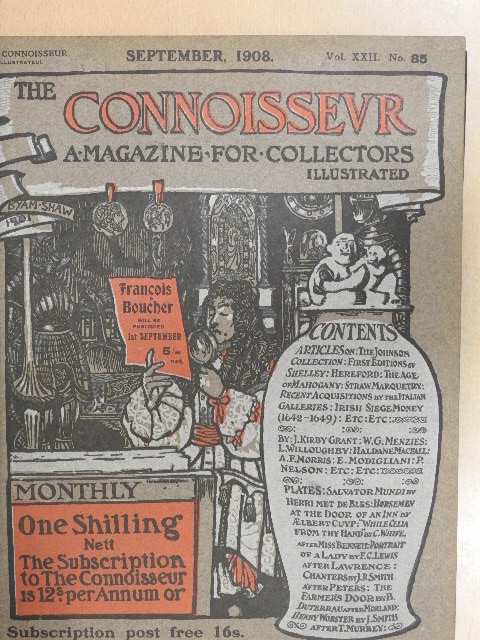
The Connoisseur Vol. XXII. 1908 [antikvár]
A. F. Morris, Ettore Modigliani, Haldane Macfall, J. Kirby Grant, Leonard Willoughby, W. G. Menzies

September, 1908.
COLLECTIONS VISITED
Mr. John G. Johnson's Collection of Pictures in Philadelphia Part III. By J. Kirby Grant
The three greatest masters of the Spanish school—Velazquez, El Greco, and Goya—are all represented among the score of Spanish pictures in Mr. Johnson's collection. But before referring to their pictures, a Madonna and Child, with saints and angels carrying the symbols of the crucifixion, must be mentioned, by the rare Valencian painter, Vicente Juan Macip, better known as Juan de Juanes (1523 P-I579), who,...
online ár:
Webáruházunkban a termékek mellett feltüntetett fekete színű online ár csak internetes megrendelés esetén érvényes.
12000 Ft

Részletesen erről a termékről
Bővebb ismertető
September, 1908.
COLLECTIONS VISITED
Mr. John G. Johnson's Collection of Pictures in Philadelphia Part III. By J. Kirby Grant
The three greatest masters of the Spanish school—Velazquez, El Greco, and Goya—are all represented among the score of Spanish pictures in Mr. Johnson's collection. But before referring to their pictures, a Madonna and Child, with saints and angels carrying the symbols of the crucifixion, must be mentioned, by the rare Valencian painter, Vicente Juan Macip, better known as Juan de Juanes (1523 P-I579), who, though not, as has been suggested, the founder of the Valencian School, counts among its greatest adherents. Though imbued to a certain extent with the Italian spirit—he may have been actually trained in Italy, but accounts of his life are scanty—he never lost the characteristics of his country's indigenous art—a certain austere purity of design and luminous depth of colour. The Italian influence appears clearly in the figure of St. George in Mr. Johnson's picture, though all the rest is unmis-takeably Spanish.
The Velazquez is a portrait of the Infanta Maria Teresa, which was formerly in the collection of the Marquis de Dorves, but is not mentioned in Beruete's severely restricted list of authentic works by the master. Nevertheless, it is a painting of such excellence that it cannot be lightly dismissed as one of the innumerable school pictures of this subject that have come down to us. No doubt whatever is attached to the
Vol. XXII.—No. 85.—a
portrait of a lady
important portrait of an unknown lady by El Greco, which was formerly in the collection of the Marquis de la Vega Indán, and has been successively known as a portrait of the Princess Eboli, the heroine of Schiller's Don Carles, and as that of El Greco's wife. Under the former name it was exhibited at the Guildhall Exhibition of Spanish Art in 1901. The elongated oval of the face, the painting of the white mantilla, the sadness and intensity of the lady's expression, are all thoroughly characteristic of the Cretan's style and mannerisms.
Whilst the two companion portraits of a lady and a gentleman which bear the name of Goya should: not give rise to any discussion as to their authorship—in quality and finish of execution they rank in this prolific master's terribly unequal work with the Doctor Peral of the National Gallery — it is impossible to accept them as presentments of the features of the actor, Isidoro Mayquez and his wife. Both tlie Prado Museum and the collection of the Marquis de Casa Torres in Madrid own authentic portraits of this mime from the brush of Goya, but the whimsical, coarse, whiskered' features, with heavy bushy eyebrows and unkempt mop-like hair, tally in no way with' those of the well-groomed, dandified,, but rather cruel-looking personality in Mr. bv el geeco Johnson's portrait.
Termékadatok
Cím: The Connoisseur Vol. XXII. 1908 [antikvár]
Szerző:
A. F. Morris
,
Ettore Modigliani
,
Haldane Macfall
,
J. Kirby Grant
,
Leonard Willoughby
W. G. Menzies
Kiadó: The Connoisseur
Kötés: Félbőr
Méret: 220 mm x 280 mm
Új vásárló vagyok!
új vásárlóval indíthatsz rendelést............